
G.I. Joe Saved 1,000 Lives
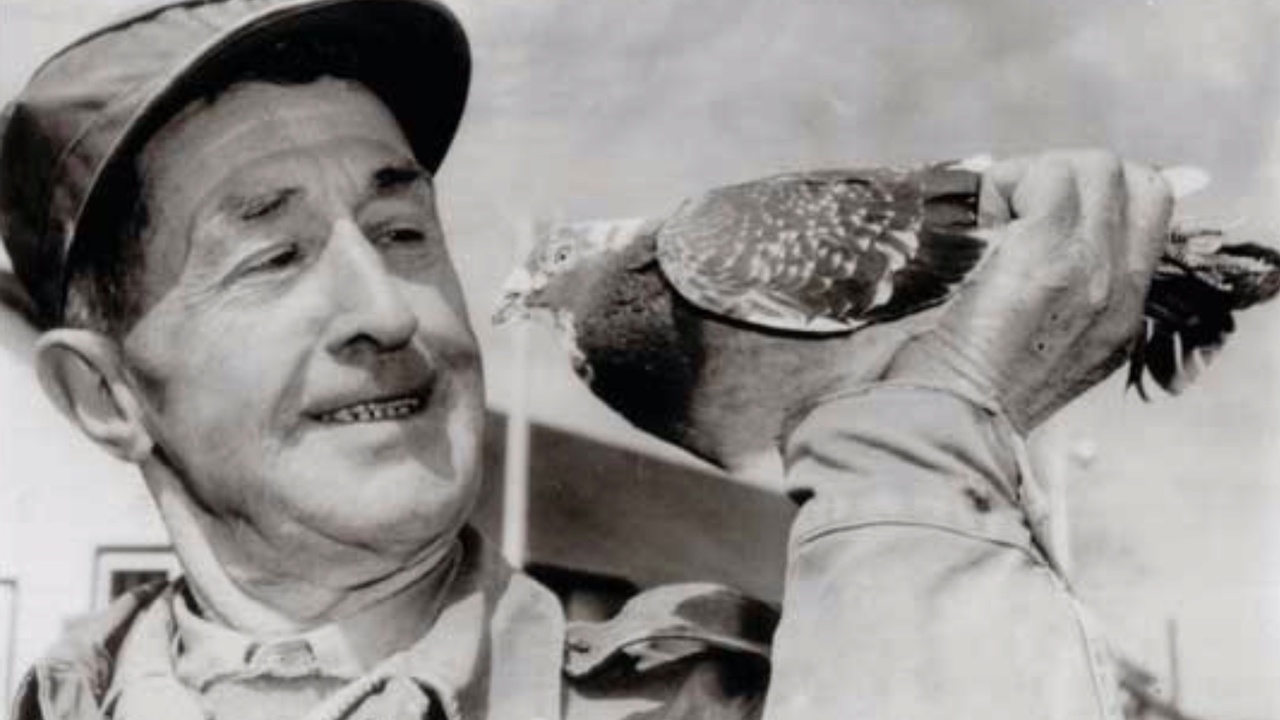
The Bird, that is. Not the Action Figure.
When their country has needed their services, carrier pigeons have answered the call of duty. Perhaps the most famous was G.I. Joe. He was an American carrier pigeon credited with saving over 100 British troops and 1000 civilians.

G.I. Joe was born (hatched) On This Day, March 24, 1943 in Algiers, North Africa.
He underwent his “basic training” for two-way homing pigeons that had been perfected at Fort Monmouth, in New Jersey. Homing pigeons were used during World War I and World War II for communication and reconnaissance purposes.
In the summer of 1917, shortly after America’s entry in World War I, the Army started a carrier pigeon service at 74 training camps and posts, including Camp Meade. (Camp Meade became a permanent fort in 1928.) The U.S. Army Pigeon Breeding and Training Center headquarters was at Fort Monmouth, NJ.

The training camps together housed over 10,000 pigeons, with another 15,000 trained birds sent to Europe for service with the American Expeditionary Forces. The Army bird trainers were known as “pigeoneers.”
The Army Pigeon Service grew to over 3,000 servicemen and 54,000 birds during World War II. The pigeons were so valuable to the war effort that the U.S. Army Veterinary Service had a unit dedicated to caring for the birds.

The 828th Signal Pigeon Replacement Company was formed at Fort Meade to train new pigeoneers, as well as continuing to train the birds.
According to the Fort Meade Post, “all inductees are asked at reception centers if their hobbies include pigeon training. Quite a number of competent pigeoneers have been found this way.”
Pigeoneers were a different kind of soldier. Their morale was above average because they were doing a job that had been their hobby in civilian life. The birds had to be cared for seven days a week.

Each of the birds had an Army serial number. G.I. Joe was Pigeon # USA43SC6390.
G.I. Joe was hatched at the Breeding section, then in Algiers, Algeria, and was taken to the Tunisian front for duty on May 1, 1943, but due to being a bit young and due to the fact that the campaign ended he was unable to be used on many missions. After the Tunisian campaign he was moved to Bizerte, Tunisia, where he remained until being moved, with many of his comrades, to the Italian Front for duty on 6 October 1943.
“G.I. Joe’s” parents were brought from the United States by members of the 6681st Signal Pigeon Company, and were landed at Safi, French Morocco the morning of November 18, 1943.
On his most important mission he was under the supervision of his two friends, Pigeoneers S/Sergeant Robert Steinhaus of Merrill, Wisconsin and T/5 Elroy Rausch of Milwaukee, Wisconsin.

On October 18, 1943, an air attack had been scheduled to subdue the German positions at the Italian village of Calvi Vecchia earlier that day, but the 6th London Infantry's advance had been far more rapid than expected, and they had won back the village from the Germans ahead of schedule— they were now in danger of getting caught up in 'friendly fire' if the attack went ahead.
All attempts to cancel the bombings of the city, made by radio and other means of communication, had failed in transmitting a message to call off the planned American air raid. Unable to get a message to the Americans to stop the bombings, they sent G.I. Joe.
A pigeon’s flying speed varies from 25 to 60 miles per hour. “Little G.I. Joe” traveled the 20 miles in 20 minutes, just in time to halt the bombings—just as the planes were preparing to take off for the target.
Here is an excerpt from the official report:
“Making what is believed the most outstanding flight yet made by a Homing Pigeon during World War II, a blue check splashed cock named “GI Joe”, and banded USA-43-SC 6390, came through from the British 10th Corps Headquarters with a message that probably saved the lives of at least 100 Allied soldiers. This story is a result of the 56th Infantry Division having made a request for Air Support to aid in the breaking of the German defense line at the heavily fortified village of Colvi Vecchia, Italy, the morning of 18 October 1943.
The message contained information that the British 169th Infantry Brigade, of the 56th Infantry Division, had captured the village of Colvi Vecchia at 10:45 hours just a few minutes before a unit of the Allied XII Air Support Command was due to bomb the town. The pigeon made the trip of some twenty odd miles, from the 10th Corps Headquarters, in the same number of minutes. The message arrived just as the planes were preparing to take off for the target; had the message arrived five minutes later it might have been a completely different story.... If “GI Joe” is living after this war he will be returned to the birthplace of his parents, there to live at Camp Crowder, Missouri as a honored hero of this second world conflict, and a veteran of two major campaigns.”
/s/ Winton T. Prater, 1st Lt., Signal Corps, Commanding
General Mark Clark, commander of the U.S. Fifth Army in World War II, credited the pigeon with saving at least 1,000 British and Italian lives.
He was one of about 54,000 pigeons – along with more than 3,000 soldiers – to serve under Maj. Otto Meyer, commander of the U.S. Army Pigeon Service, who called G.I. Joe “the most outstanding military pigeon in history.

In November 1946, G.I. Joe was shipped to London for a ceremony, and on November 4, 1946, G.I. Joe was presented the Dickin Medal for gallantry by Major-General Charles Keightley and the city’s Lord Mayor at the Tower of London the citation credits him with the most outstanding flight made by a United States Army homing pigeon in World War II.

The award is also known as the equivalent of the Victoria Cross or the Medal of Honor for animals. G.I. Joe was the 29th and the first non-British recipient of the medal. In 2019 he was also posthumously awarded the Animals in War & Peace Medal of Bravery.

G.I. Joe got through World War II and was housed at the U.S. Army's Churchill Loft at Fort Monmouth, in New Jersey along with 24 other heroic pigeons.

He lived out his retirement at the Detroit Zoological Gardens, and died at the age of eighteen. He was mounted and displayed at the U.S. Army Communications Electronics Museum at Fort Monmouth.


Post Script: G.I. Joe followed in the heroic wingflaps of Cher Ami, who was one of 600 birds owned and flown by the U.S. Army Signal Corps in France during World War I.
A War Department memo from WWII stated: “In Tunisia, it was found that pigeons, when well trained, can compete with, or beat, all other means of communication when flying distances less than 15 miles.”
A pigeon named Cher Ami was the most famous of them all. The rescue of almost 200 men from “The Lost Battalion” during the Meuse-Argonne offensive of World War I was due to Cher Ami.
The American battalion was trapped inside enemy lines and was taking on artillery shelling from U.S. forces, who were unaware of their location. After the first two pigeons with messages for the rear were shot down by the Germans, the battalion’s last bird, Cher Ami, was released with a message in the canister attached to her leg. “We are along the road parallel to 276.4. Our own artillery is dropping a barrage directly on us. For heaven’s sake, stop it.”
The bird managed to get through the German fire, but when she delivered the message she was covered in blood from a bullet hole in her breast and was blinded in one eye. Veterinarians had to amputate half of one leg. The French military awarded the Croix de Guerre to the bird, who was stuffed and is on display at the Smithsonian Institution.
Another pigeon named President Wilson was assigned to Col. George Patton’s tank battalion in World War I. The bird was released from a tank turret with messages about enemy locations or requests for artillery support. He also saw action in the Meuse-Argonne offensive, delivering a message through a wall of German bullets in record speed. When he arrived, his left leg had been shot off and he, too, had a bullet wound in his breast.
Cher Ami was awarded the French Croix de Guerre with palm, and he was later inducted into the Racing Pigeon Hall of Fame. He died in 1919 as a result of battle wounds incurred during delivery of a message that saved nearly 200 men who had been isolated from other American forces.

The effectiveness of the training program at Fort Meade, as well as the birds’ incredible instinct, were displayed in June 1943. Fort Meade’s pigeoneers would take baskets of the birds and release them in Laurel as part of their training to find their way back to the loft. After one such exercise, all the birds had returned by sundown except one, who was named Clarence.
According to the Fort Meade Post, “at 3 p.m. the next day, Lt. Walter Schmidt was gazing down the company street in the direction of Laurel. There was Clarence strutting sedately down the road toward his home loft. It seems that Clarence had fallen in oil. His feathers were plastered so closely to his body that flying was out of the question.”
Due to the advancement in electronic communication, pigeons became obsolete as a method of communication and the Army Pigeon Service was shut down in 1957.