The Inventor of Long-Distance Television also invented the Color Fax and the Changeable Sign!
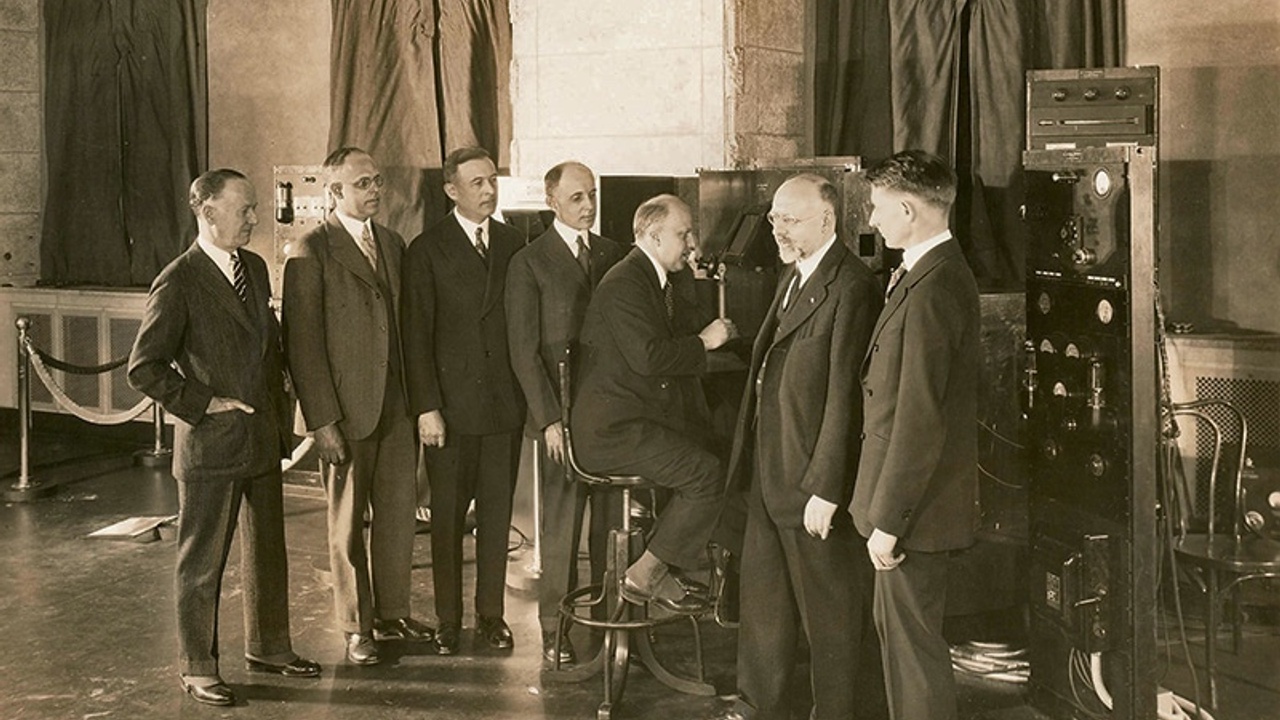
On This Day, April 7, 1927, Herbert Eugene Ives of Bell Laboratories and the inventor of long-distance television transmission, broadcasts a picture from Washington D.C. to New York, a distance of about 200 miles over telephone lines.

It was a speech by then U.S. Secretary of Commerce and future U.S. President Herbert Hoover announcing, "Today we have, in a sense, the transmission of sight for the first time in the world's history. Human genius has now destroyed the impediment of distance in a new respect, and in a manner hitherto unknown."

Ives was born on July 31, 1882 in Philadelphia to Frederic Eugene Ives and Mary Olmstead. He studied at the University of Pennsylvania.
Just like his father, Herbert Ives became an expert in color photography. His main point of interest was aerial photography. He was also an avid coin collector.
In 1903, Ives patented the technique for the "Changeable Sign", which showed different pictures from different angles.
He continued his studies at Johns Hopkins University, where he graduated in 1908. He married Mabel Lorenz in the same year and they had three children.

In 1920, while serving as an Army reserve aviation officer, he wrote a book on aerial photography.
He was president of the Optical Society of America from 1924 to 1925, until Bell Labs hired him to be their Director of Electro-Optical Research. There, with a team of more than 200 scientists, engineers and technicians, Ives worked on developing videotelephony and television for both telecommunications and broadcast entertainment purposes.

In 1924, during his first year at Bell Labs, Ives sent and received the first color facsimile, a color photograph of silent film star Rudolph Valentino, using the basic methods of color separations, methods that are still used today by modern printers.
He is best known for the 1938 Ives–Stilwell experiment, although Ives himself did not accept special relativity, and argued instead for an alternative interpretation of the experimental results.

And yet, Ives’ most notable research was wholly unintended—called the Ives-Stilwell experiment, he meant to disprove the special theory of relativity's time dilation. The experiment was a great success, only because it didn’t go according to plan. The results of the experiment directly confirmed Einstein’s special theory of relativity. Probably a bit miffed, Ives claimed that the results could be interpreted differently.
Ongoing research into combined audio and video telephones was extended by Bell Labs far past Ives' tenure at a cost of over $500 million, eventually resulting in the deployment of AT&T's futuristic Picturephone.
From Fax’s, TV, 3D Photography, to confirming the Theory of Relativity, Herbert Eugene Ives certainly made an impact that has endured to this day.
Ives died at the age of 70, on November 13, 1953 in Upper Montclair, New Jersey. He’s buried in Litchfield, Connecticut.