
The Inventor of the Shopping Cart also invented the Baggage Cart
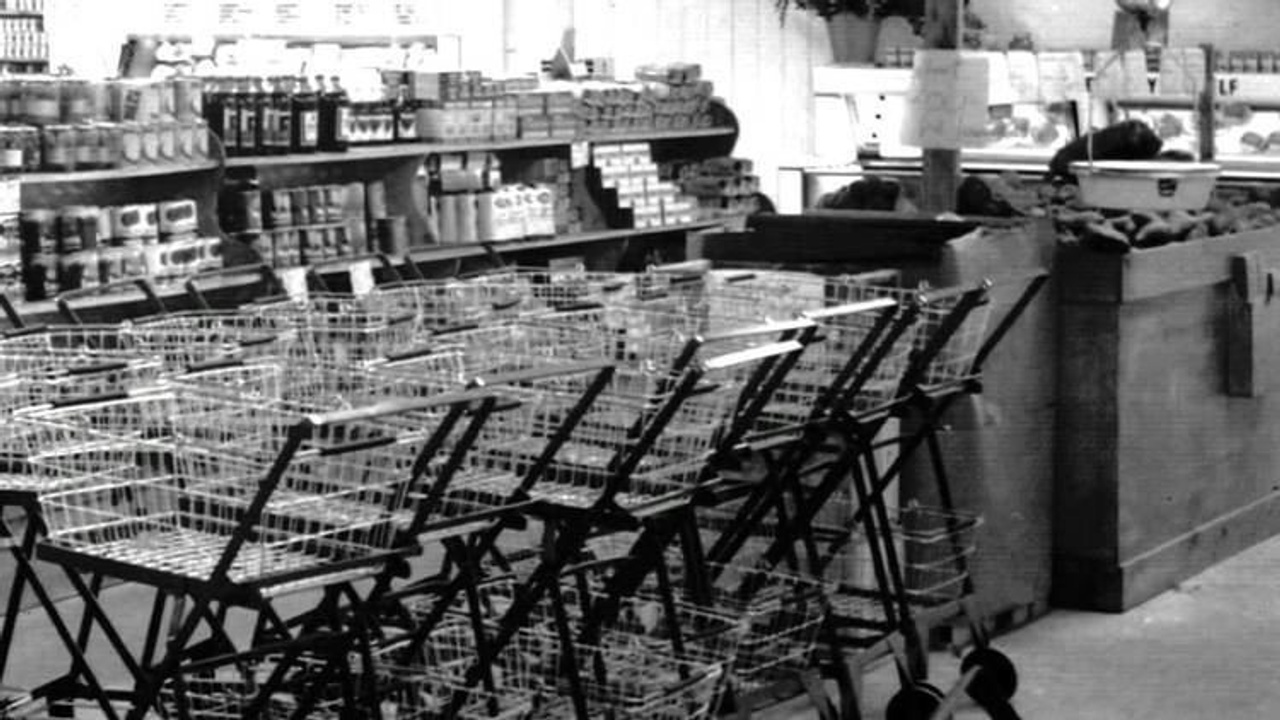
On This Day, April 9, 1940, the patent for the first shopping cart is granted to its inventor Sylvan Goldman, the owner of a Humpty Dumpty Grocery store in Oklahoma City. It was essentially a folding chair with wheels and baskets attached. The carts were initially a flop, as shoppers were reluctant to use them--men found them effeminate and women thought them too much like a baby carriage - so he hired models to shop with them.

Eventually, folding carts became very popular and Goldman became a multimillionaire by collecting a royalty on every folding design shopping cart in the United States.
By any measure, Goldman was an innovator. In addition to his invention of the shopping cart, early in his career as a grocer he developed many of the advertising and marketing techniques now commonly used by supermarkets.
He once said his idea for the shopping cart came from watching women carrying baskets. ''They had a tendency to stop shopping when the baskets became too full or too heavy,'' he said.
Sylvan Goldman was born on November 15, 1898, in Ardmore, Oklahoma then known as part of the Chickasaw Nation.
His mother had emigrated from France and his father from Latvia.
He had one older brother, Alfred. His father worked at various dry goods stores owned by his wife's family, one of which was located in Indian territory where Sylvan was born.
Sylvan learned the retail trade from his father and his mother's uncles who were merchants in pioneer Oklahoma.
Goldman was 15 when his family moved to Tulsa and he went to work in one of his uncle’s stores. He was not educated past the eighth grade. Two years later, he volunteered for Army service in World War I and served as a food requisitionist in France.
His brother served in the Army as well, but was discharged for health reasons.
Following the honorable discharge, he joined his brother and other relatives in one, then another, chain of grocery stores.
After the war, in 1919, Sylvan and his brother Alfred opened the Goldman Brothers Wholesale Fruits and Produce in Breckenridge, Texas. They were initially very successful due to the then oil boom in Texas, but their situation quickly deteriorated once the boom ended.
The brothers then moved to California, where they worked for grocery wholesalers. Initially planning on opening their own wholesale food business in California, they instead returned to Oklahoma at the behest of their uncles who wanted to start their own retail food store chain. The uncles offered to put up all the money as well as to cede the brothers a 75% interest in the venture. Accepting the generous offer and armed with an understanding of a new store concept that they had seen in California, the "supermarket" – where all different types of food were available for sale in a single store and customers served themselves – they returned to Oklahoma and founded the state's first supermarket, the Sun Grocery Company.
They opened their first store on April 3, 1920, at 1403 East Fifteenth Street in Tulsa, Oklahoma, with Sylvan serving as president and Alfred as vice president. Within one year, they were operating twenty-one Sun Grocery markets throughout the state. Within three years, they had fifty-five stores.
In 1929, they sold the Sun chain to Skaggs-Safeway Stores several months before the Stock Market Crash of 1929.
On June 7, 1931, Goldman married Margaret "Babe" Katz— the daughter of Jake Katz, founder of Katz Department Store in Stillwater, Oklahoma. They had two sons: Monte Henry Goldman and Alfred Dreyfus Goldman.

Despite reaping a generous and timely sum from the Safeway sale, Goldman and his brother, Alfred, lost much of their fortune in the crash; and being banned from competing with Safeway in Tulsa due to a non-competition agreement, they moved to Oklahoma City where they purchased five grocery stores and formed a new company called Standard Grocery.

During the 1930’s when 10 grocery store chains in Oklahoma City closed their doors, the Goldmans bought the Humpty Dumpty chain at a bankruptcy sale in 1934, and implementing the lessons they had learned in Tulsa, built it into one of central Oklahoma’s largest chains.

Alfred died in 1937.
In 1943, Sylvan merged the two brands into one company: Standard-Humpty Dumpty.
Sylvan Goldman would say of the grocery industry, “The wonderful thing about food is that everyone uses it, and they only use it once.”
Around this time shoppers were buying new, heavier kinds of products but still using hand baskets to carry them. The increase in canned goods and refrigerated items inspired Goldman to make shopping easier for his customers.

After watching women carrying baskets while often handling children as they shopped for groceries, he observed, ''They had a tendency to stop shopping when the baskets became too full or too heavy.”
Concerned with alleviating their difficulty, he grabbed his handyman Fred Young and a few supplies, and the two spent a night coming up with a prototype of a rolling grocery basket. Basing his design on that of a wooden folding chair, they built it with a metal frame and added wheels and wire baskets.
He introduced the device on June 4, 1937, in the Humpty Dumpty supermarket chain in Oklahoma City, of which he was the owner.

Another mechanic, Arthur Kosted, developed a method to mass-produce the carts by inventing an assembly line capable of forming and welding the wire.
In 1936, Goldman founded the Folding Carrier Corporation, to manufacture it.
On March 14, 1938, Goldman filed for a patent of his idea, and on April 9, 1940 his cart was awarded patent number 2,196,914, titled, "Folding Basket Carriage for Self-Service Stores".
They advertised the invention as part of a new "No Basket Carrying Plan."

The invention did not catch on immediately. Men found them effeminate; women found them suggestive of a baby carriage. "I've pushed my last baby buggy," offended women informed him.
After hiring several male and female models to push his new invention around and in front of his store to demonstrate their utility, as well as greeters to explain their use, his folding-style shopping carts became extremely popular. Goldman began selling his carts to competitors, and quickly turned his former folding chairs into a booming business.

Goldman became a multimillionaire by collecting a royalty on every folding design shopping cart in the United States.
He eventually became involved in the building of supermarkets and shopping centers.

Meanwhile, in Missouri, business owner and machinist Orla Watson came up with a design for a grocery cart that improved upon Goldman’s basket-carriers—an innovative "nesting" shopping cart that did not require disassembly after each use as Goldman's designs did, and which allowed for the shopping carts to telescope, or "nest", by simply shoving or “nesting” multiple carts together in supermarkets and parking lots instead of disassembling them.

Watson filed for a patent in 1946, but had his invention contested by Goldman. In the meantime, Goldman produced replicas of the nesting carts to compete against the new challenger.

Goldman patented his own "Nest-Kart" over a year later in 1948, and sold his new carts for three dollars less than Watson’s, using his manufacturing resources to effectively drive his competitor out of the market.
An interference investigation was ordered by Watson of Telescope Carts, Inc. for alleged patent infringement.
Finally, after an extended legal battle, Watson was granted the patent in 1949.

In a compromise solution, Goldman agreed to relinquish his rights on his existing patent and agreed to pay the sum of $1 for counterfeit damages.
In return, Telescope Cart, Inc. agreed to an exclusive license granted to Goldman's company for the production of the telescoping, or "nesting", cart. The telescoping cart, based on the patent issued to Watson, forms the basis of the shopping cart designs used to the present, and all royalties for the new design were paid to Telescope Carts, Inc. until their patent expired.
The design of the grocery cart would remain the same for decades, but minor additions helped shape the cart into what it is today. Most notably, carts were outfitted with seats for children beginning in the mid-1950s. These seats cemented the grocery cart as a supermarket necessity.

Other inventions by Goldman includes the grocery sacker, the folding inter-office basket carrier, and the handy milk bottle rack. Goldman also invented the baggage cart.
Goldman was active in a full variety of pursuits, to include: insurance, savings and loan associations, banking, real estate, and land development.
He retired as head of Goldman Enterprises in 1982 after amassing a $200 million + fortune, partly from the shopping cart and the Humpty-Dumpty retail food chain.
The shopping cart became a major development in the history of merchandising.

Goldman and his wife were known for their philanthropic and humanitarian efforts, many of them conducted anonymously.
Sylvan Goldman’s wife of 53 years, Margaret Katz Goldman, passed away on November 18, 1984 at the age of 78.

One week later, on Sunday, November 25, 1984, Sylvan died at the age of 86.

Referred to as ''The Cart that Changed the World,'' the invention of the shopping cart has impacted the lives of virtually all Americans and hundreds of millions of people around the world. As well, the shopping cart spawned many other inventions that have aided retail in countless ways.

“There is no question that his has been one of the few inventions that made possible the self-service operation in supermarkets and drugstores or general merchandise stores.”
- L.A. Times, 1978