On this Day, March 3, 1931, Francis Scott Key's song The Star-Spangled Banner is adopted as the American national anthem by Congress.
But how that happened exactly is little-known to most. To put it simply, it was an evolution and a process...but to put it mildly, it was not at all simple.

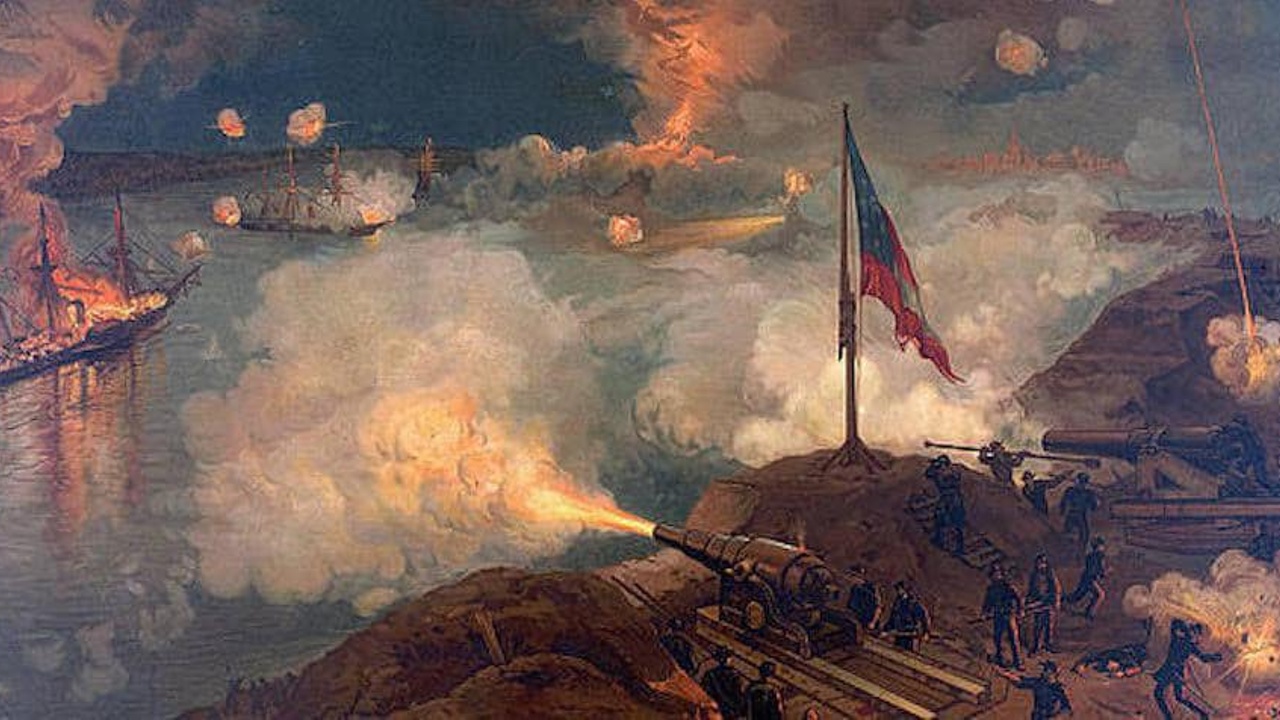
Of course, Key wrote the song in 1814 after seeing the American flag flying following the British bombardment of Ft. McHenry during the War of 1812.
But in writing the song, Key borrowed widely from other songs and melodies, often with very similar lyrics.
Long assumed to have originated as a drinking song, the melody was taken from the song “To Anacreon in Heaven,” which first surfaced about 1776 as a club anthem of the Anacreontic Society, an amateur mens’ music club in London. Written by British composer John Stafford Smith—whose identity was discovered only in the 1970s by a librarian in the music division of the Library of Congress—the song was sung to signal a transition between the evening’s orchestral music concert and after-dinner participatory singing. In short, it was indeed a drinking song of sorts.
In 1798 the tune became “Adams and Liberty,” written by Thomas Paine (not the same person as the author of Common Sense, with whom he’s sometimes confused) to celebrate and rally support for the nation’s second president, John Adams. This version of the song remained popular and well known through the War of 1812, until Key wrote his new lyrics and appropriated the tune.
The melody was used repeatedly throughout the 18th and 19th centuries with lyrics that changed with the affairs of the day.
Early in September 1814, after the British had burned the city of Washington, Key was sent on a potentially dangerous mission to the British fleet near Baltimore to secure the release of his friend William Beanes, a physician from Upper Marlborough, Maryland. Beanes’ family and friends, unable to successfully negotiate his release, hoped that Key, then a prominent Washington attorney, could be more effective.

Key secured permission to intercede from President James Madison and from Commissioner General of Prisoners John Mason. Army Colonel John Skinner, who had arranged several exchanges of British naval officers, accompanied Key. Mason also asked the senior British prisoner in Washington, Colonel William Thornton, to have his fellow prisoners write letters describing their humane treatment. Key collected the letters before he left.
Riding on horseback, Key met Skinner in Baltimore on September 4. The following day, the two men sailed under a safe-conduct flag on an American cartel ship. They found the British command vessel, Tonnant, on September 7 at the mouth of the Potomac River. They soon entered into prisoner-exchange negotiations with General Robert Ross and Rear Admiral George Cockburn.
Ross and Cockburn, swayed by the letters from the British prisoners, agreed to release Beanes but with one provision: that Key, Skinner, and Beanes not leave the harbour until after the attack on Baltimore. The three men were put under guard on an American ship during the 25-hour bombardment of Fort McHenry, the main fort in the harbour that defended the city.

As a result of this, Key was unable to do anything but watch the bombarding of the American forces at Fort McHenry during the Battle of Baltimore on the night of September 13 – September 14, 1814. Key said later that onboard the ship, they were “tossed as though in a tempest” as the night wore on.
In the early morning dawn of September 14 when Key—who was also an amateur poet—saw the American flag still flying over the fortress, a signal that the British had been defeated, scribbling on the back of a letter he was carrying, he began to write the words that would become “The Star-Spangled Banner.”

Released from his brief captivity that day, Key rewrote the poem in a Baltimore hotel.
Historians say a handbill with the lyrics was probably printed on September 17, three days before Colonel Skinner stepped in. He said later that he had taken it from Key and “passed it to The Baltimore Patriot [& Evening Advertiser], and through it to immortality.”
Newspapers often published poems and ballads in those days, and three days after Key had completed it, he submitted it anonymously under the title “Defence of Fort M’Henry” and on September 20th, was published by The Baltimore Patriot.

And yet, the article about the new song didn’t even make the front page. It appeared on Page 2, but the newspaper said the song itself was “destined long to outlast the occasion, and outlive the impulse, which produced it.”
Key’s song was not just stop-the-press news, it was start-the-press news. The paper had not come out in almost two weeks. With the British closing in on Baltimore, the staff had been engaged in the defence of the city, so the song also served as a unique time capsule into the time in which it was printed, capturing the mood of the city after what can only be described as a miraculous victory.

Up til then, the War of 1812 had been going badly for the Americans. But now, Congress was meeting again, less than a month after the British had burned the United States Capitol and the President’s House, not yet famous as the White House. President James Madison had been forced to flee Washington.
Key had already used Composer John Stafford Smith's "To Anacreon in Heaven" as the tune for his 1805 song "When the Warrior Returns," celebrating U.S. heroes of the First Barbary War. The earlier song is also Key's original use of the "star spangled" flag imagery.
The song caught on, and its author, Francis Scott Key, became famous for it after it was retitled “The Star-Spangled Banner.”

Key’s song became especially popular and a powerful expression of patriotism during the Civil War, with its emotional description of the enduring national flag, which had become the symbol of the still-new nation. In 1861, devastated by the split of the nation, poet Oliver Wendell Holmes wrote a fifth verse to Key’s song. The verse was included in many of the song’s printings throughout the war. The song was recognized in 1889 by the U.S. Navy, who sang it when raising and lowering the flag, and then it was proclaimed in 1916 by President Woodrow Wilson to be the national anthem of all the armed forces.
Many variations of the song developed in both words and music, until an official arrangement was prepared in 1917 by a committee that included Walter Damrosch and John Philip Sousa for the Army and Navy.

In 1929, Robert Ripley — of “Ripley’s Believe It or Not!” fame — published a syndicated cartoon stating that “Believe It or Not, America has no national anthem.”

The public outcry was immediate and resounding. Americans were shocked and Ripley received an angry backlash. He told letter-writers that their efforts would be better spent writing their congressmen. Five million letters soon arrived in Washington demanding that Congress proclaim a national anthem.
The “Star-Spangled Banner” had since become one of the most popular patriotic songs of the United States, used widely, particularly by the Navy during flag-raising ceremonies, but other songs were also used at official occasions, to include “Hail Columbia” and “America (My Country, ‘Tis of Thee)”.
“The Star Spangled Banner” by the time of the Civil War and by the late 19th century had become the official song of the U.S. military, but it was never declared the official national anthem of the country.
The song has since become better known as "The Star Spangled Banner". Under this name, the song was adopted as the American national anthem, first by an Executive Order from President Woodrow Wilson in 1916, which had little effect beyond requiring military bands to play the War Department standard arrangement to be used by U.S. military bands. But it was not until the 1918 World Series that the song took hold of America during a game that almost didn’t happen.

America had been involved in World War One for a year. Out of respect for the soldiers, baseball officials wanted to cancel the World Series between the Boston Red Sox and the Chicago Cubs. When it became known, however, that American soldiers fighting in France were eager to know the Series’ results, the games commenced. To honor these brave men, the officials had the band play the Star-Spangled Banner during the seventh-inning stretch of the first game. Comiskey Park in Chicago erupted in song as the spectators and players stood and joined in. Soon it became tradition to play the Star-Spangled Banner at all baseball games and, eventually, nearly all sporting events.
Prior to this World Series game, there had been a push to make the song our official anthem. The push gained momentum after the World Series as citizens and legislators worked tirelessly to make it happen. Finally, after twenty years and forty bills and resolutions, it became a reality.

On April 15, 1929, Representative John Linthicum of Maryland introduced to the House, H.R. 14, a bill to make the song penned by Francis Scott Key during the 1814 British siege of Fort McHenry in Baltimore Harbor, the national anthem. Nearly a year later, Linthicum secured a hearing with the Judiciary Committee and implored his colleagues to attend with a speech that claimed the nation "needed a national song to give expression to its patriotism.” The Maryland Congressman also submitted a petition that contained more than five million individual signatures, resolutions and letters from 150 organizations, and “letters and telegrams from 25 governors . . . asking that the bill be enacted into law.” The bill passed the House on April 21, 1930. Critics claimed that Linthicum, whose district encompassed parts of Baltimore, was as eager to promote city history as national patriotism. Moreover, they complained that the old “drinking” song was ill-suited to the average vocal range. As one of the final acts of the 71st Congress (1929–1931), H.R. 14 passed the Senate. Even after the anthem bill was enacted newspapers continued to criticize the necessity of such a law.
After Ripley’s cartoon spurred the American people to demand “The Star Spangled Banner” to become the official national anthem there was some debate in Congress on whether a song with somewhat violent subject matter should be the official anthem.
In 1931, John Philip Sousa published his opinion in favor of giving the song official status, stating that "it is the spirit of the music that inspires" as much as it is Key's "soul-stirring" words.
After a century of general use, the four-stanza song was officially adopted as the national anthem by an act of Congress, and on March 3, 1931, President Herbert Hoover signed a law making the “Star-Spangled Banner” the undisputed national anthem.

The long journey from a poem written on the back of a letter to our country’s national anthem took 117 years.

Key’s original lyrics of “The Star-Spangled Banner,” since revised, are as follows:
O say can you see, by the dawn’s early light,
What so proudly we hail’d at the twilight’s last gleaming,
Whose broad stripes and bright stars through the perilous fight
O’er the ramparts we watch’d were so gallantly streaming?
And the rocket’s red glare, the bomb bursting in air,
Gave proof through the night that our flag was still there,
O say does that star-spangled banner yet wave
O’er the land of the free and the home of the brave?
On the shore dimly seen through the mists of the deep
Where the foe’s haughty host in dread silence reposes,
What is that which the breeze, o’er the towering steep,
As it fitfully blows, half conceals, half discloses?
Now it catches the gleam of the morning’s first beam,
In full glory reflected now shines in the stream,
’Tis the star-spangled banner—o long may it wave
O’er the land of the free and the home of the brave!
And where is that band who so vauntingly swore,
That the havoc of war and the battle’s confusion
A home and a Country should leave us no more?
Their blood has wash’d out their foul footstep’s pollution.
No refuge could save the hireling and slave
From the terror of flight or the gloom of the grave,
And the star-spangled banner in triumph doth wave
O’er the land of the free and the home of the brave.
O thus be it ever when freemen shall stand
Between their lov’d home and the war’s desolation!
Blest with vict’ry and peace may the heav’n rescued land
Praise the power that hath made and preserv’d us a nation!
Then conquer we must, when our cause it is just,
And this be our motto—“In God is our Trust,”
And the star-spangled banner in triumph shall wave
O’er the land of the free and the home of the brave.
#OTD #NationalAnthem #American #History #Flag #FrancisScottKey #Song #Anthem#Ripley #BelieveitorNot #Linthicum #FortMcHenry #Stories