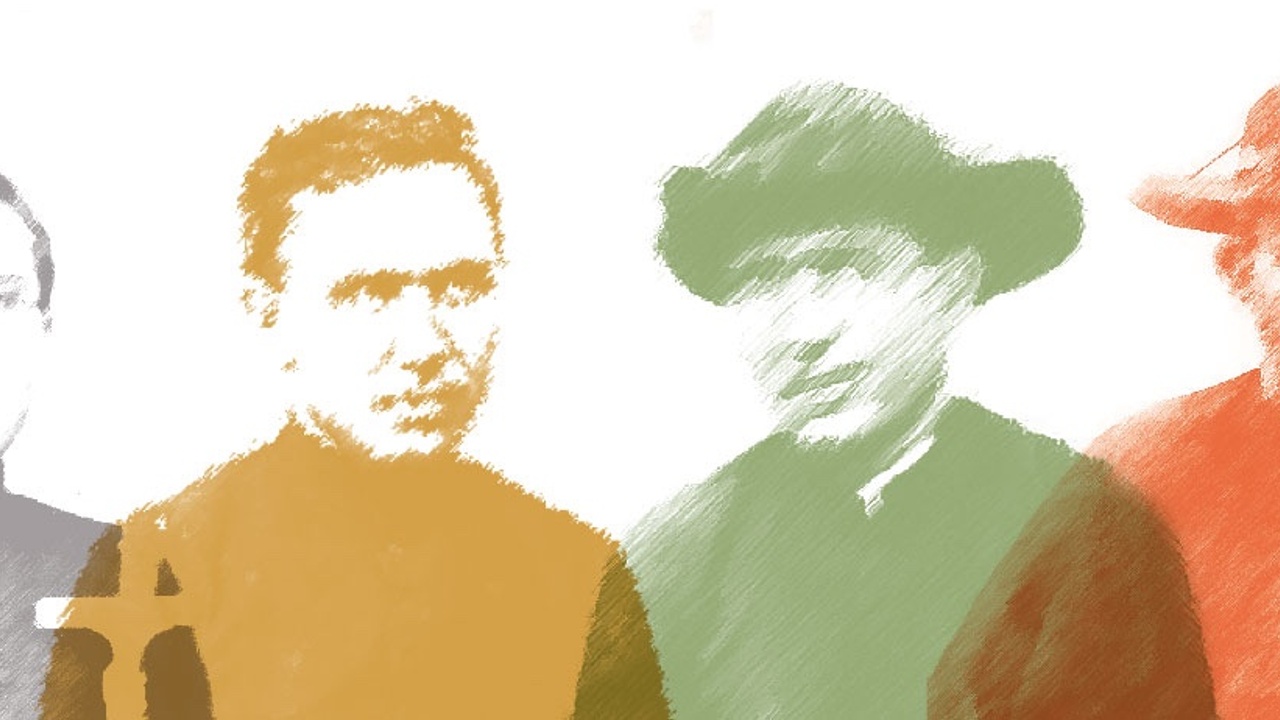
Father Damien was born Jozef De Veuster, was a Roman Catholic priest from Belgium, and missionary who dedicated his life to the lepers of Hawaii and eventually contracted the disease himself. He was declared a Saint by the Catholic Church. Father Damien has been described as a "martyr of charity". In the Anglican Communion and other Christian denominations, Damien is considered the spiritual patron for leprosy and outcasts.

Jozef De Veuster was the youngest of seven children and fourth son of the Flemish corn merchant Joannes Franciscus ("Frans") De Veuster and his wife Anne-Catherine ("Cato") Wouters in the village of Tremelo in Flemish Brabant in rural Belgium on 3 January 1840. His older sisters Eugénie and Pauline became nuns, and his older brother Auguste (Father Pamphile) joined the Congregation of the Sacred Hearts of Jesus and Mary (Picpus Fathers).
Jozef was forced to quit school at age 13 to work on the family farm.
His father, a small farmer, sent him to a college at Braine-le-Comte, to prepare for a commercial profession; but as a result of a mission given by the Redemptorists in 1858, Joseph decided to pursue a religious profession. He entered the novitiate of the Fathers of the Sacred Heart of Jesus and Mary at Louvain, and took the name of Damien on October 7, 1860–to honor the first Saint Damian, a fourth-century physician and martyr.

While he was not considered unintelligent, his superiors thought that he was not a good candidate for the priesthood because he lacked education. He learned Latin well from his brother, so he was allowed to become a priest. During his religious studies, Damien prayed daily before a picture of St. Francis Xavier, patron of missionaries, to be sent on a mission. Three years later, in 1863, when his brother Father Pamphile (Auguste) could not travel to the Sandwich (Hawaiian) Islands as a missionary because of illness, Damien was allowed to take his place.

On March 19, 1864, Damien arrived at Honolulu Harbor on Oahu. He was ordained into the priesthood on 21 May 1864, at what is now the Cathedral of Our Lady of Peace.
In 1865 Damien was assigned to the Catholic Mission in North Kohala on the island of Hawaiʻi. While he was serving in several parishes on Oʻahu, the Kingdom of Hawaiʻi was struggling with a labor shortage and a public health crisis.
Many of the Native Hawaiian parishioners had high mortality rates due to infectious diseases such as smallpox, cholera, influenza, syphilis, and whooping cough, brought to the Hawaiian Islands by foreign traders, sailors and immigrants. Thousands of Hawaiians died of such diseases, to which they had no acquired immunity.

It is believed that Chinese workers carried leprosy (later known as Hansen's disease) to the islands in the 1830s and 1840s. At that time, leprosy was thought to be highly contagious and was incurable. In 1865, out of fear of this contagious disease, Hawaiian King Kamehameha V and the Hawaiian Legislature passed the "Act to Prevent the Spread of Leprosy." This law quarantined the lepers of Hawaii, requiring the most serious cases to be moved to a settlement colony of Kalawao on the eastern end of the Kalaupapa peninsula on the island of Molokaʻi.
Later the settlement of Kalaupapa was developed. Kalawao County, where the two villages are located, is separated from the rest of Molokaʻi by a steep mountain ridge. From 1866 through 1969, about 8,000 Hawaiians were sent to the Kalaupapa peninsula for medical quarantine.
The Royal Board of Health initially provided the quarantined people with food and other supplies, but it did not have the workforce and resources to offer proper health care. According to documents of that time, the Kingdom of Hawaiʻi did not intend for the settlements to be penal colonies. Still, the Kingdom did not provide enough resources to support them.
The Kingdom of Hawaii had planned for the lepers to be able to care for themselves and grow their crops. Still, due to the effects of leprosy and the peninsula's local environmental conditions, this was impractical.
While Bishop Louis Désiré Maigret, of the Honolulu diocese, believed that the lepers needed a Catholic priest to assist them, he realized that this assignment had high risk. He did not want to send any one person "in the name of obedience."

Four priests volunteered to go, among them was Father Damien. The bishop planned for the volunteers to take turns in rotation assisting the inhabitants. Soon Damien was on a boat carrying cattle and 50 patients bound for Kalawao.
They were not the first caregivers or religious workers to arrive at Kalawao. They followed Congregational ministers, Catholic priests, Mormon elders, and family and friends of patients who went voluntarily to Kalawao to help.
On May 10, 1873, Father Damien arrived at the isolated settlement at Kalaupapa, where there were then 600 lepers, and was presented by Bishop Louis Maigret. At his arrival, he spoke to the assembled lepers as "one who will be a father to you, and who loves you so much that he does not hesitate to become one of you; to live and die with you."
At the time there was no cure for leprosy and those who contracted the disease were shunned.

There were about eight hundred lepers on the island when Father Damien arrived and the number continued to grow. Living conditions were so terrible that Damien referred to the place as a “living cemetery.” He visited the lepers in their huts and brought them the sacraments. He also made efforts to improve the roads, harbor, and water supply and to expand the hospital. His multiple responsibilities were said to have included those of a pastor, physician, counselor, builder, sheriff, and undertaker. In one of his letters home, he wrote: “I make myself a leper with the lepers...”
Damien worked with them to build a church and establish the Parish of Saint Philomena.

In addition to serving as a priest, he dressed residents' ulcers, built a reservoir, built homes and furniture, made coffins, and dug graves. Six months after his arrival at Kalawao, he wrote to his brother, Pamphile, in Europe: "...I make myself a leper with the lepers...."
He undertook many projects, cared for the lepers and established leaders within the community to improve their living conditions. He aided the colony by teaching, painting houses, organizing farms, organizing the construction of chapels, roads, hospitals, and churches. He also dressed residents, dug graves, built coffins, ate food by hand with lepers, shared pipes with them, and lived with the lepers as equals. Father Damien also served as a priest during this time and spread the Catholic faith to the lepers; it is said that Father Damien told the lepers that despite what the outside world thought of them, they were always precious in the eyes of God.
Father Damien returned to Honolulu to beg for money, clothing and medicine and as news of his ministry spread, donations began to pour in from all over the world.

Father Damien was a catalyst for a turning point for the community. Under his leadership, basic laws were enforced, shacks were upgraded and improved as painted houses, working farms were organized, and schools were established. At his request and of the lepers, Father Damien remained on Molokaʻi.
He improved water and food supplies and housing and founded two orphanages, receiving help from other priests for only 6 of his 16 years on Molokai.
King David Kalākaua bestowed on Damien the honor of "Knight Commander of the Royal Order of Kalākaua."

When Crown Princess Lydia Liliʻuokalani visited the settlement to present the medal, she was reported as having been too distraught and heartbroken at the sight of the residents to read her speech. The princess shared her experience, acclaiming Damien's efforts.

Consequently, Damien became internationally known in the United States and Europe. American Protestants raised large sums of money for the missionary's work. The Church of England sent food, medicine, clothing, and supplies to the settlement. It is believed that Damien never wore the royal medal, although it was placed by his side at his funeral.

Father Damien worked for 16 years in Hawaii, providing comfort for the lepers of Kalaupapa. Slowly, Kalawao became a place to live rather than a place to die.
He gave the people not only faith and hope but also homes, and his own medical expertise. He would pray at the cemetery of the deceased and comfort the dying at their bedsides.
He spoke the Hawaiian language. Assisted by patients, he built houses, constructed a water system, and planted trees. He also organized schools, bands, and choirs. He provided medical care for the living and buried the dead. He expanded St. Philomena Catholic Church.

Not a "retiring" personality, Damien did not hesitate to badger the Hawaiian government and his church for more resources. These efforts attracted worldwide attention, resulting in a heightened awareness of the disease and the plight of its victims. He returned to Honolulu to beg for money, clothing and medicine and as news of his ministry spread, donations began to pour in from all over the world.
In December 1884, while preparing to bathe, Damien inadvertently put his foot into scalding water, causing his skin to blister. He felt nothing and realized he had contracted leprosy after 11 years of working in the colony. This was a common way for people to discover that they had been infected with leprosy. Despite his illness, Damien worked even harder.
Having contracted Leprosy, he was forbidden to leave the island. Volunteers and most visitors stopped coming.

"His cassock was worn and faded, his hair tumbled like a school-boy’s, his hands stained and hardened by toil; but the glow of health was in his face, the buoyancy of youth in his manner; while his ringing laugh, his ready sympathy, and his inspiring magnetism told of one who in any sphere might do a noble work, and who in that which he has chosen is doing the noblest of all works. This was Father Damien."
--Charles Warren Stoddard, who visited Kalawao in 1884
In 1885, Masanao Goto, a Japanese leprologist, came to Honolulu and treated Damien onsite. He believed that leprosy was caused by a diminution of the blood. His treatment consisted of nourishing food, moderate exercise, frequent friction to the benumbed parts, special ointments, and medical baths. The treatments did relieve some of the symptoms and were very popular with the Hawaiian patients. Damien had faith in the treatments and said he wanted to be treated by no one but Goto, who eventually became good friends with Father Damien.

Among his other best friends were Meyer, a Lutheran, the superintendent of the leper colony, Clifford, an Anglican, and Moritz, a free-thinker who was the doctor on Molokai.
Despite the illness slowing his body, Damien engaged in a flurry of activity in his last years. He tried to complete and advance as many projects as possible with his remaining time. While continuing to spread the Catholic Faith and aid the lepers in their treatments, Damien completed several building projects and improved orphanages.
Four volunteers arrived at Kalaupapa to help the ailing missionary: a Belgian priest, Louis Lambert Conrardy; a soldier, Joseph Dutton (an American Civil War veteran); a male nurse, James Sinnett from Chicago; and Mother (now also Saint) Marianne Cope, who had been the head of the Franciscan-run St Joseph's Hospital in Syracuse, New York. Conrardy took up pastoral duties. Cope organized a working hospital. Dutton attended to the construction and maintenance of the community's buildings. Sinnett nursed Damien in the last phases of illness.

With an arm in a sling, a foot in bandages, and his leg dragging, Damien knew death was near. He was bedridden on March 23, 1889, and on March 30th, he made a general confession.


On his deathbed, he said, "It is the will of God, and I thank Him very much for letting me die of the same disease and in the same way as my lepers."
Damien died of leprosy at 8:00 a.m. on April 15, 1889, at the age of 49. The next day, after Mass said by Father Moellers at St. Philomena's, the whole settlement followed the funeral cortège to the cemetery.

As he requested, Damien was laid to rest under the same pandanus tree where he first slept upon his arrival on Molokaʻi.


News of his death was quickly carried across the globe by the modern communications of the time, by steamship to Honolulu and California, telegraph to the East Coast of the United States, and cable to England, reaching London on May 11th. Following an outpouring of praise for his work, other voices began to be heard in Hawaiʻi.
In January 1936, at the request of King Leopold III of Belgium and the Belgian government, Damien's body was returned to his native land in Belgium in Leuven. It was transported aboard the Belgian ship Mercator. Damien was buried in Leuven, the historic university city close to the village where he was born. After Damien's beatification in June 1995, the remains of his right hand were returned to Hawaii and re-interred in his original grave on Molokaʻi.


And yet, before and after Damien’s death, rumors persisted, accusing him of immorality.
His superiors thought Damien lacked education and finesse but knew him as "an earnest peasant hard at work in his own way for God."

Reverend Charles McEwen Hyde, a Presbyterian minister in Honolulu, wrote in August to fellow pastor Reverend H. B. Gage of San Francisco. Hyde referred to Father Damien as "a coarse, dirty man," who contracted leprosy due to "carelessness." Hyde further asserted that Damien was mistakenly being given credit for reforms made by the Board of Health. Without consulting with Hyde, Gage had the letter published in a San Francisco newspaper, generating comment and controversy in the US and Hawaiʻi. While it was the case that the role of Hawaiians was often overlooked or ignored, several did indeed have prominent leadership roles on the island.
Later in 1889, Scottish author Robert Louis Stevenson and his family arrived in Hawaii for an extended stay. He had tuberculosis, then also incurable, and was seeking some relief. Moved by Damien's story, he became interested in the priest's controversy and went to Molokaʻi for eight days and seven nights.

Stevenson wanted to learn more about Damien at the place where he had worked. He spoke with residents of varying religious backgrounds to learn more about Damien's work. Based on his conversations after interviewing local Hawaiians, and his personal observations, he wrote a famously passionate 6,000-word defense of Damien in an open letter to Hyde that addressed the minister's criticisms and had it printed at his own expense. This became the most famous account of Damien:
“If that world at all remember you, on the day when Damien of Molokai shall be named a Saint, it will be in virtue of one work: your letter to the Reverend H. B. Gage.”
Stevenson referred to his journal entries in his letter:
“...I have set down these private passages, as you perceive, without correction; thanks to you, the public has them in their bluntness. They are almost a list of the man's faults, for it is rather these that I was seeking: with his virtues, with the heroic profile of his life, I and the world were already sufficiently acquainted. I was besides a little suspicious of Catholic testimony, in no ill sense, but merely because Damien's admirers and disciples were the least likely to be critical. I know you will be more suspicious still, and the facts set down above were one and all collected from the lips of Protestants who had opposed the father in his life. Yet I am strangely deceived, or they build up the image of a man, with all his weakness, essentially heroic, and alive with rugged honesty, generosity, and mirth.”
Mahatma Gandhi said that Father Damien's work had inspired his social campaigns in India, leading to independence for his people and securing aid for those who needed it. Gandhi said,
“The political and journalistic world can boast of very few heroes who compare with Father Damien of Molokai. The Catholic Church, on the contrary, counts by the thousands those who, after the example of Fr. Damien, have devoted themselves to the victims of leprosy. It is worthwhile to look for the sources of such heroism.”
Because Kalaupapa remained an isolation settlement and the world could not come to his church and grave, Damien’s remains were exhumed in 1936 and reburied at Louvain, Belgium. In 1995 a relic composed of the remains of his right hand was returned to his original grave at Kalawao, to the great joy of Kalaupapa and the rest of Hawai`i.
When Hawaii became a state in 1959, it selected Damien as one of its two representatives in the Statuary Hall at the United States Capitol.
In 1977, Pope Paul VI declared Father Damien to be venerable. On 4 June 1995, Pope John Paul II beatified him and gave him his official spiritual title of Blessed. On 20 December 1999, Jorge Medina Estévez, Prefect of the Congregation for Divine Worship and the Discipline of the Sacraments, confirmed the November 1999 decision of the United States Conference of Catholic Bishops to place Blessed Damien on the liturgical calendar with the rank of an optional memorial. Father Damien was canonized on 11 October 2009 by Pope Benedict XVI. His feast day is celebrated on May 10th.

Two miracles have been attributed to Father Damien's posthumous intercession. On June 13, 1992, Pope John Paul II approved the cure of a nun in France in 1895 as a miracle attributed to Venerable Damien's intercession. In that case, Sister Simplicia Hue began a novena to Father Damien as she lay dying of a lingering intestinal illness. It is stated that the pain and symptoms of the illness disappeared overnight.
In the second case, Audrey Toguchi, a Hawaiian woman who suffered from a rare form of cancer, had remission after having prayed at the grave of Father Damien on Molokaʻi. There was no medical explanation, as her prognosis was terminal.
In 1997, Toguchi was diagnosed with liposarcoma, a cancer that arises in fat cells. She underwent surgery a year later and a tumor was removed, but the cancer metastasized to her lungs. Her physician, Dr. Walter Chang, told her, "Nobody has ever survived this cancer. It's going to take you." Toguchi was surviving in 2016.
In April 2008, the Holy See accepted the two cures as evidence of Father Damien's sanctity. On June 2, 2008, the Congregation for the Causes of Saints at the Vatican voted to recommend raising Father Damien of Molokaʻi to sainthood. The decree that officially notes and verifies the miracle needed for canonization was promulgated by Pope Benedict XVI and Cardinal José Saraiva Martins on July 3, 2008, with the ceremony taking place in Rome and celebrations in Belgium and Hawaii.
On February 21, 2009, the Vatican announced that Father Damien would be canonized. The ceremony took place in Rome on October 11, 2009, in the presence of King Albert II of the Belgians and Queen Paola as well as the Belgian Prime Minister, Herman Van Rompuy, and several cabinet ministers, completing the process of canonization.

In 1952, the Picpus Fathers opened the Damien Museum, in Tremelo, Belgium, in the house where Damien was born and grew up. In 2017 the museum was completely renovated.

No person is as central to the history of Kalawao and Kalaupapa as Joseph De Veuster, or, as he is best known to the world—Father Damien.
When he was born in 1840, few people had any firsthand knowledge of leprosy, Hansen’s disease. But by the time he died at age 49, people all over the world knew about this disease because of him.
He is known today as a hero of charity because he identified so closely with the victims of leprosy.

Father Damien Day—April 15th—the day of his death, is also a minor statewide holiday in Hawaii. Father Damien is the patron saint of the Diocese of Honolulu and of Hawaii.


Post Script: Father Damien was not the last saint of Kalaupapa. Mother Marianne Cope, who had come to Kalaupapa in 1888 as Father Damien was dying, to look after him and to take over parts of his role after his death, was also canonized by the Pope in 2012, as Kalaupapa's (so far) second official Saint.

The leper colony was strictly speaking not the only settlement on Kalaupapa peninsula. In 1906, a massive lighthouse was built (at the time the “brightest light in the Pacific”!) at the northern tip of the peninsula and alongside it houses for the lighthouse keepers and their families were provided.

Their isolation was in way even greater, as they were prohibited from having any contact with the leper community just a mile and a half away. Yet despite the rules and the fears it is said that some interaction did indeed take place, when members of the community came up to the lighthouse to speak to the keepers' families to comfort them in their loneliness! The lighthouse's beam of light sweeping across the ocean and along the sea cliffs was also cherished by the settlement's inhabitants as something soothing – and they'd often come out at night just to watch it. The lighthouse was automated in 1966, and the last keeper departed for good. The old light may be gone, but the slender white tower is still one of the most noticeable landmarks of the area.

Outside of Kalaupapa and Hawaii, meanwhile, medical science made progress in understanding the true nature of leprosy. Already in 1873 the bacillus causing the disease was discovered by one Dr. Hansen in Norway. It has hence also become known as Hansen's Disease since. Yet it took until the 1940s for a proper cure to be developed.

The new sulfone drug, an antibiotic to treat leprosy, first applied in Kalaupapa in 1946 soon proved to be highly successful. It also turned out that sufferers treated with the drug ceased to be contagious. This led to dramatic changes to the world's leper colonies. In the case of Kalaupapa and Hawaii, the official isolation policy was not abolished until 1969! Yet in practical terms it had already more or less ended by 1950.
Formerly exiled patients were now allowed to travel – and people from the outside world came to visit Kalaupapa, including famous celebrities like Shirley Temple and John Wayne who came to perform. Public attitudes towards the disease and the people afflicted with it, who had been so deeply stigmatized for millennia, were clearly beginning to change.
Despite all that, many Kalaupapa residents who were now free to leave their place of exile did not want to go. They had become attached to their little isolated piece of land and its spirit of community. The former prison had become home.
Still today a number of former patients (nine, at the time of writing) remain as residents in Kalaupapa, wishing to live out their lives here. It was partly for their protection, to make sure their wishes are respected and their memories honoured, that Kalaupapa was made a National Park in 1980.
Outside access to the settlement is therefore tightly controlled and visitors are required to respect the residents' privacy. Not all residents of Kalaupapa are former patients, though. In fact the majority are now National Park employees.
The physical isolation of Kalaupapa has hardly changed. Land access is limited to a steep mule path. Otherwise there's only an airstrip for small aeroplanes. Once a year a barge delivers goods by sea that are too bulky to make it to the island any other way (cars, for example).
Currently the National Park service is addressing the question of what is to become of Kalaupapa in the future when no more former patients live here and the co-management with the Department of Health will, for that reason, end. A number of alternative plans are under consideration. This may include the opening of a proper museum at the site (a sizeable collection of objects has already been accumulated).
Whether access to the public will be eased remains to be seen. Issues at stake also include environmental ones. For instance, the National Park also contains rare species not found anywhere else, and these will require continued protection.