The Inventor of the First Mass Produced Car also Invented Stainless Steel Cutlery—and Oversaw Construction of the First Long-Distance Natural Gas Pipe
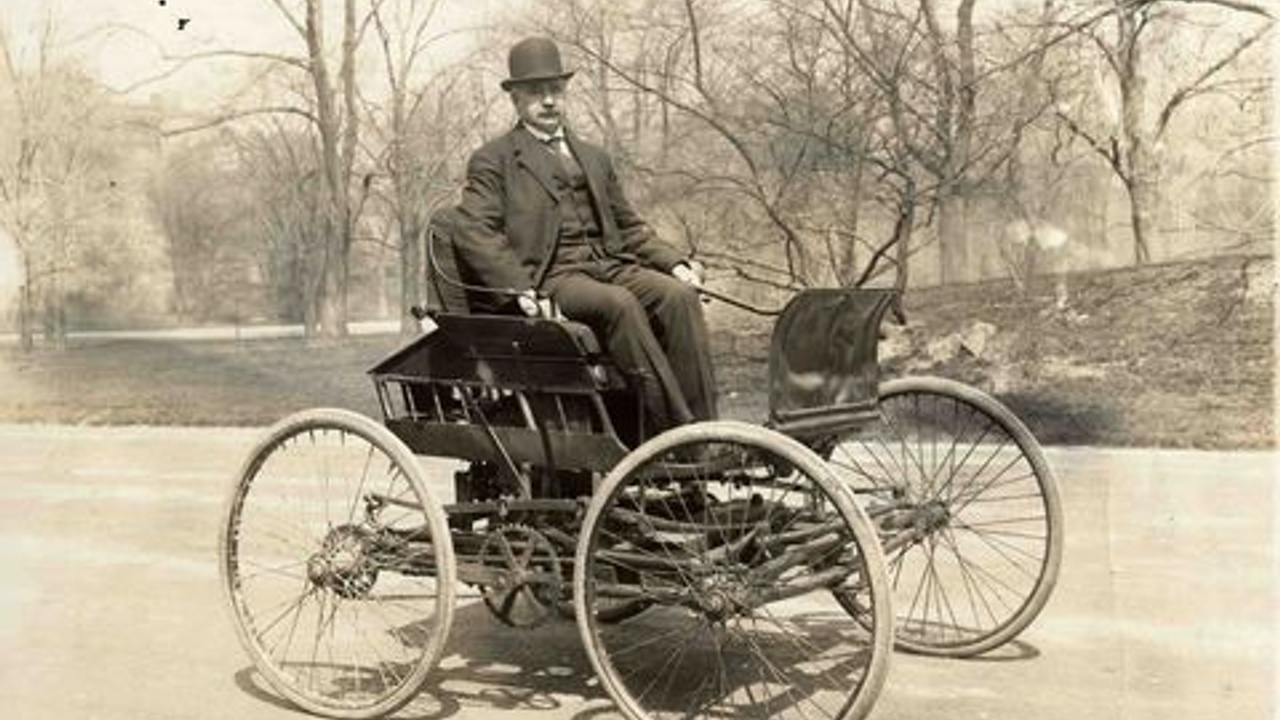
American inventor, metallurgist, automotive pioneer, entrepreneur and industrialist, Elwood Haynes developed and built one of the first automobiles. For anyone, that would be more than enough for a lifetime achievement—but he was responsible for so many more invaluable contributions that endure to this day.

Haynes was born on October 14, 1857, in Portland, Indiana, the fifth of ten children of Jacob M. Haynes and Hilinda S. Haines Haynes. His family was of English descent.
Both of Haynes' parents were dedicated Presbyterians and outspoken prohibitionists and educated their children from a young age to avoid liquor. His mother was the founder of a local Women's Temperance Movement Union. His paternal grandfather Henry Haynes was a gunsmith and mechanic, and tutored Haynes about metallurgy. In 1866, the family moved from their two-room house in Portland into the countryside outside of town where they purchased a larger home to better accommodate their growing number of children.

At age 12, Haynes built his first vehicle from scrap railroad car parts and operated it on the county's railroad tracks. The local railroad foreman did not approve and later seized the vehicle and destroyed it.
As a child, Haynes had an interest in chemistry and metallurgy and when he was 15 he built a smelting furnace and began working with copper, bronze, and iron.
His early experiments and studies interested him in the fundamental properties of matter, and he was intrigued by how mixing compounds could create completely different alloys.
Haynes was also interested in nature and spent considerable time in the forest cataloging and observing plants, insects, and animals. Because he spent so much time there, his family nicknamed him "Wood", a nickname they used for most of his life.
Even as early as his student days in the early 1880's, Elwood Haynes was interested in metal alloys. His senior thesis, "The Effect of Tungsten on Iron and Steel," is said to have come about as a result of his desire to find a material for razors which did not rust and tarnish.
After graduation from WPI and graduate studies at Johns Hopkins, Haynes returned to his native Indiana where he supervised laying of natural gas lines to Chicago.
Early in his career, while serving as a field superintendent at gas and oil companies during Indiana's gas boom, Haynes invented several devices important to the advance of the natural gas industry. When working for the Indiana Natural Gas and Oil Company, he oversaw the construction of the first long-distance natural gas pipeline in the United States, connecting Chicago with the Trenton Gas Field 150 miles away.
He began experimenting on a carriage powered by an internal combustion engine to provide faster transportation over long distances than the horse drawn carriage. The first trial run of his horseless carriage on July 4, 1894, in Kokomo, Indiana—a one-horsepower, one-cylinder vehicle —which he called the Pioneer— on July 4, 1894, in Kokomo, Indiana.

Haynes’ future partners, Edgar and Elmer Apperson, had notified the Kokomo townspeople of the test drive and a crowd gathered to witness the event. Haynes was concerned that his vehicle could injure someone in the crowd, so he had the vehicle towed by a horse and buggy to Pumpkinvine Pike, away from the crowd. The car started with Haynes driving and Elmer Apperson riding as a passenger, and traveled at 7 mph. He traveled for 1.5 miles and then stopped the vehicle to manually turn it around with Elmer's help. He proceeded to drive it several more miles back into town without stopping. His trip convinced him that the vehicle was worthwhile and could become a valuable enterprise, although he was disappointed in the vehicle's handling and decided he needed to improve the steering system and find a way to divert the motor's exhaust smoke away from the carriage.
This qualified Haynes as the inventor of the very first automobiles made in the United States, eight years after the first automobile was patented in Germany.
Haynes claimed that he received the first U.S. traffic ticket when in 1895 a policeman on a bicycle ordered him and his automobile off the streets of Chicago.
In 1895, while driving one of his early automobiles, he swerved to avoid a street car and struck a curb, busting his tire and axle. This is believed to be the first automobile accident in the U.S.
He is recognized for having created the earliest American design that was feasible for mass production and, with the Apperson brothers, he formed the first company in the United States to produce automobiles profitably, in 1898.
He made many advances in the automotive industry, to include a successful carburetor, the first muffler, and the use of aluminum in automobile engines.

Now on exhibition at the Smithsonian Institution, Washington, D.C., Haynes’s vehicle is the oldest American-made automobile in existence.
Haynes and the Appersons split up in 1902, and three years later the company name was changed to Haynes Automobile Company. It ceased operations in 1925.
A trained engineer and chemist, Haynes discovered a number of alloys, including tungsten chrome steel in 1881, a chromium and nickel alloy in 1897, and a chromium and cobalt alloy in 1900. He discovered a stainless steel in 1911 and patented it in 1919. He was the first to use aluminum in an automobile engine.
He also discovered tungsten chrome steel in 1881, and the metal alloy stellite in the early 1900s as a material for making cutlery that wouldn't stain or require constant cleaning. Stellite remains an important metal, as its ability to withstand high temperatures has made it a component in American spacecraft.
Haynes independently co-discovered martensitic stainless steel along with Englishman Harry Brearley in 1912, patenting stainless steel in 1919.
Haynes created the first set of stainless steel silverware.
Haynes continued his research in metal alloys, producing a cobalt-chromium alloy which would be used in dental and surgical instruments.
In 1922, Haynes received the prestigious John Scott Medal for his "discoveries in stainless steel, stellite, and chrome-iron."
An outspoken advocate of prohibition, he made substantial donations to the Prohibition Party.
Haynes ran an unsuccessful campaign in Indiana for the U.S. Senate in 1916 as a prohibition candidate and remained active in the party until prohibition became law.
Later, he became a philanthropist and served two terms as president of the YMCA, five years on the Indiana Board of Education, and was an active member of the Presbyterian church.
Haynes' fortune had shrunk considerably with the collapse of his auto company. He still held an estimated $2.85 million—$35 million in today’s dollars— in stocks, bonds, and other assets, but almost all of his cash savings were gone.
He had already been forced to borrow money using future dividends and royalties as collateral, leaving his family with some difficulty in coming up with funds to maintain his home.

Elwood Haynes died On This Day, April 13, 1925 from complications arising from influenza.
Haynes' estate was left to his wife who continued to live in the family mansion until her own death from a stroke in August 1933.
His Kokomo mansion was converted into the Elwood Haynes Museum and is open to the public where many of his original inventions and automobiles are on display.