The Accidental Sale of the First Ford Mustang...and How Ford Got it Back
On this Day, March 9, 1964, Ford began production of its new sports car, the Mustang.
At that moment in time, the U.S. economy was booming, the first Beatles record had just been released, LBJ had announced his War on Poverty, and the country was still trying to shake off the November 1963 assassination of President John F. Kennedy.
Cars were a positive distraction, and the release of the Ford Mustang was no exception.
The Mustang’s styling, with its long hood and short deck, proved wildly popular and inspired a host of competition.

At a base price of $2,368, it was originally intended to be a mid-engine two-seated roadster, but that changed when the sales of the Thunderbird increased after adding a back seat.
Since it was introduced four months before the normal start of the 1965 production year, the earliest Mustangs are widely referred to as the 1964½ model by enthusiasts.
Before the car officially hit the sales floor on April 17, 1964, Ford wanted every dealership to have a display model when sales began, so approximately 180 pre-production cars built at the Ford River Rouge Complex between February 10 and March 5, 1964 that could be shipped to every major Ford dealer in time for the April 17th launch.
Logically, the first cars built were sent to the farthest dealers – hence, Serial Number One wound up 2,180 miles from Dearborn in St. John's, Newfoundland.
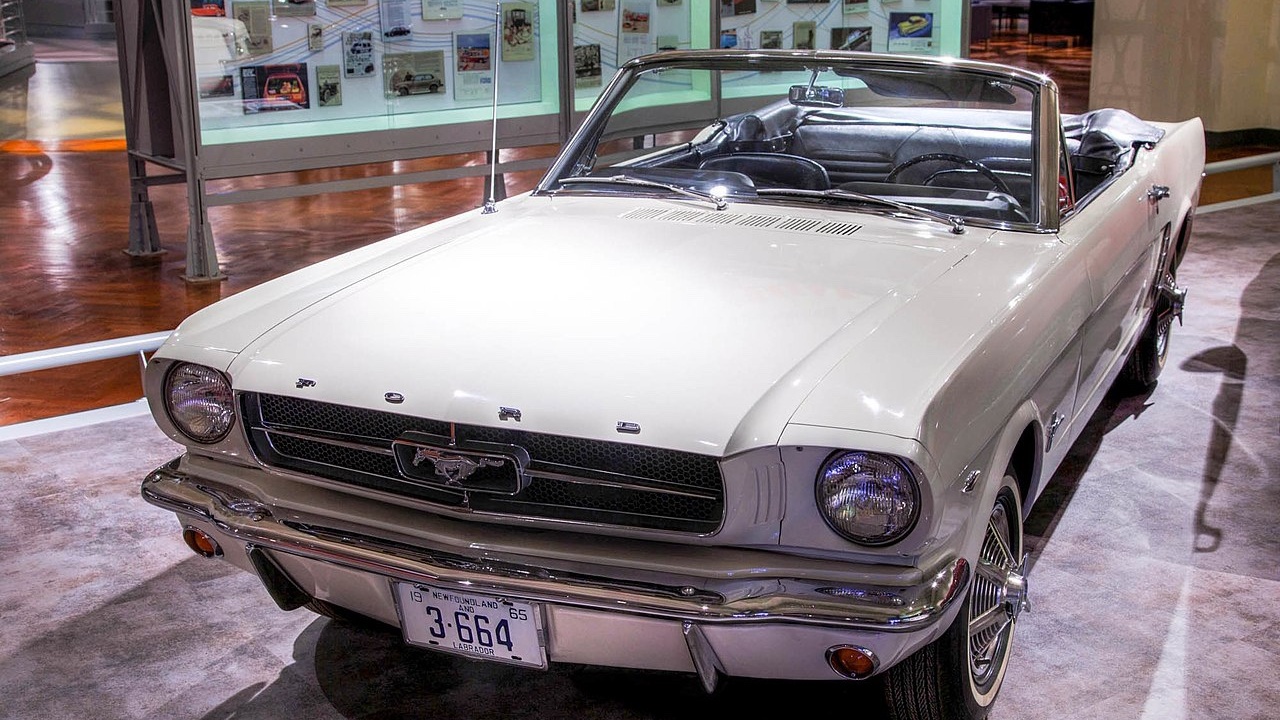
Mustang “Serial Number One” was shipped to George Parsons Ford, a dealership perched on the eastern edge of the continent in St. John's. It was painted Wimbledon White with serial number 5F08F100001.
On April 13, 1964, Eastern Provincial Airlines pilot Captain Stanley Tucker was driving past the Ford dealer when he noticed a big crowd in the dealership on introduction day and stopped in to see what the commotion was about. By the time he finished dinner that evening, he decided that he had to have that car.
Harry Phillips (Salesman of the First Mustang)

On April 14, 1964, Tucker walked into the showroom. Mr. George Parsons, owner of the dealership, wanted to retain the car for a few days because it was the only Mustang he had in stock, but Captain Tucker persuaded his young salesman, Harry Phillips, to break street date and make it available three days before the Mustang would be officially released to the world.
“We had it on display in the outside lot close to the street where everybody could see it,” when Stanley Tucker walked through the showroom door, said Phillips, now 86.
“It was probably the easiest sale I ever made in my life. I just happened to be standing by the door.”
Harry Phillips remembers that Tucker said, “I want it, I want it.” Phillips says he responded, “Yes!, Yes, yes!”
A deal was reached and a check was written on the spot. Tucker took serial number 5F08F100001 home and, for a short time, was the general public's only Mustang owner.

At the time, he had no idea he had purchased the first Mustang ever ordered. "For a long time I was the only Mustang owner in Newfoundland. It was quite an experience" Captain Tucker recalled.
"Many time other motorist would force me to the side of the road to ask me about the car -- what it was, who made it, how did I like it and how much did it cost?"
Meanwhile, Ford wanted all of the pre-production cars shipped back to Dearborn. Had that happened, Serial Number 5F08F100001 would likely have been scrapped. Most of the others were.
But that memo didn’t get to the sales team at George G.R. Parsons Ford
It was months before anybody at Ford HQ in Dearborn knew Mustang No. 001 had jumped the corral and was running free.
“The serial number didn’t mean anything to us,” Phillips said. “We didn’t know it was the first one made. “We didn’t realize the significance of the car 'til Ford came looking for it.”
Once it became known a couple of weeks later that Mustang Number One had been inadvertently sold, Ford officials reached out to Tucker and begged to buy it back. Tucker declined the request.

"I said 'I'm sorry, you've cashed my cheque and I've got the car and I'm very happy with it,' and I just refused to give them the car back," said Tucker.
“Ford called our manager and wanted the car back,” Phillips said. “He told 'em, ‘We can’t do anything. Talk to the fella who bought it.' ”
The Ford Mustang sold an industry record of 417,000 units in its first year.

Tucker spent the next two years putting some 10,000 miles on his pony car. By early 1966, when nearly one million Mustangs had been sold and the car's status as a Ford landmark was secure, the Ford Motor Company called again.

This time, Ford offered Tucker a worthy trade: in exchange for returning Serial Number One, he could have the One Millionth Mustang free of charge, equipped to his specifications. Tucker agreed and, when filling out the order, covered the entire option sheet with single large “X”.

The car was a silver frost convertible with a black top, a deluxe black interior with a wood-grain steering wheel, styled steel wheels, Cruise-O-Matic transmission, air conditioning, stereosonic tape player, disc brakes and rally pac. It even had a Philco television. The only extra he didn't take was the High Performance 289 engine – it carried a shorter warranty period.

After two years of enjoying his first-ever-produced Mustang, Tucker finally gave in to Ford, and drove the car from St. John's to Dearborn, Michigan where Ford wined and dined him in the company of executives such as Lee Iacocca and Don Frey. On March 2, 1966, Tucker's loaded '66 Mustang convertible rolled off the line amid fanfare and excitement, and Tucker made the exchange the new model — one millionth Mustang to roll off the line.
Ford soon donated the original car to The Henry Ford Museum, in Dearborn, Michigan, where it is on display to this day.

After taking delivery of the Millionth Mustang early in 1966, Tucker pressed it into daily use in all kinds of weather, including nasty Canadian winters. The elements took their toll. Through the years, he drove the Mustang thousands of miles. He even pulled a trailer with it. By the time the 1970s came around, Tucker knew it was time to sell the Mustang and opt for something new. He sold the car to his mechanic and never saw it again.

Incidentally, the second Mustang built — a hardtop — went to a dealership in the Yukon. It recently sold at auction for $175,000. Only one other preproduction ’65 Mustang is known to have survived.
As for the salesman of the first Ford Mustang sold, Harry Phillips remained in the car business until retiring in 1995, selling Fords nearly the whole time.

Phillips had not seen the original Mustang he’d sold since the day Captain Tucker drove it off the lot. He seemed surprised to learn people from around the world visit the Henry Ford to see it with it's Newfoundland and Labrador licence plate, on display in the Henry Ford Museum.

In 2019, on the 55th Anniversary of the Ford Mustang, Harry Phillips received a VIP tour of the museum and Rouge plant where Ford built Mustang Serial No. 1, reuniting with the car for the first time since he’d sold it.
“I just want[ed] to see the museum and the car,” Phillips said.