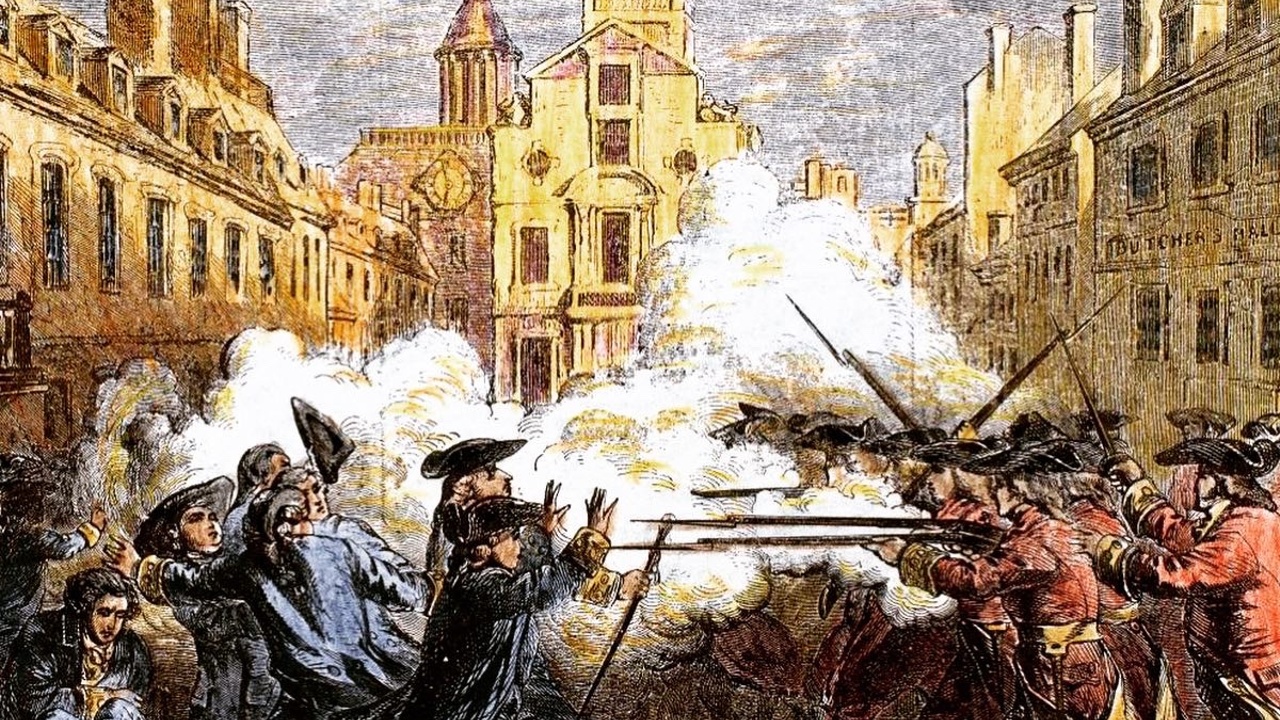
On This Day, March 5, 1770, British Army troops fire into a Boston mob, killing five. Paul Revere, Samuel Adams, and others used the event to call for rebellion against the British authorities. Future U.S. President John Adams defended the troops in a court case that established the presumption of innocence.

A mob of Boston colonists had formed around a British sentry who was guarding the King's money stored inside the Custom House. The colonists began insulting the guard who struck one with his bayonet. The colonists retaliated by throwing snow and stones.

The guard, fearing a riot and concerned for the loss of the King's money, called for reinforcements. When the colonists began striking the officers with clubs they fired back, killing five people and wounding six others.

Eight British soldiers and their officer in charge, Captain Thomas Preston, faced charges for murdering the five colonists.

Not far from the Custom House, a 34-year-old Boston attorney sat in his office and made a difficult decision. Although a devout patriot, John Adams agreed to risk his family’s livelihood and defend the British soldiers and their commander in a Boston courtroom. At stake was not just the fate of nine men, but the relationship between the motherland and her colonies on the eve of the American Revolution. The British soldiers were found not-guilty of murder, but two of them were found guilty of manslaughter and were branded on the thumbs as first offenders per English law.
John Adams in his opening comments for the defense of eight British soldiers accused of murder,
"…that many guilty persons should escape unpunished, than one innocent person should suffer. The reason is, because it's of more importance to community, that innocence should be protected, than it is, that guilt should be punished; for guilt and crimes are so frequent in the world, that all of them cannot be punished; and many times they happen in such a manner, that it is not of much consequence to the public, whether they are punished or not. But when innocence itself, is brought to the bar and condemned, especially to die, the subject will exclaim, it is immaterial to me, whether I behave well or ill; for virtue itself, is no security. And if such a sentiment as this, should take place in the mind of the subject, there would be an end to all security what so ever."
This set the precedence for presumption of innocence of clients and that they must be proven guilty as opposed to proving they are innocent.

This trial was also the first time the phrase "reasonable doubt" was used in court when Justice Peter Oliver instructed the jury, "If upon the whole ye are in any reasonable doubt of their guilt, ye must then, agreeable to the rule of law, declare them innocent."

The five colonists–included Crispus Attucks, a local dockworker of mixed racial heritage, Samuel Gray, a rope maker who was left with a hole the size of a fist in his head. Sailor James Caldwell was hit twice before dying, and Samuel Maverick and Patrick Carr were mortally wounded. Six were wounded.