
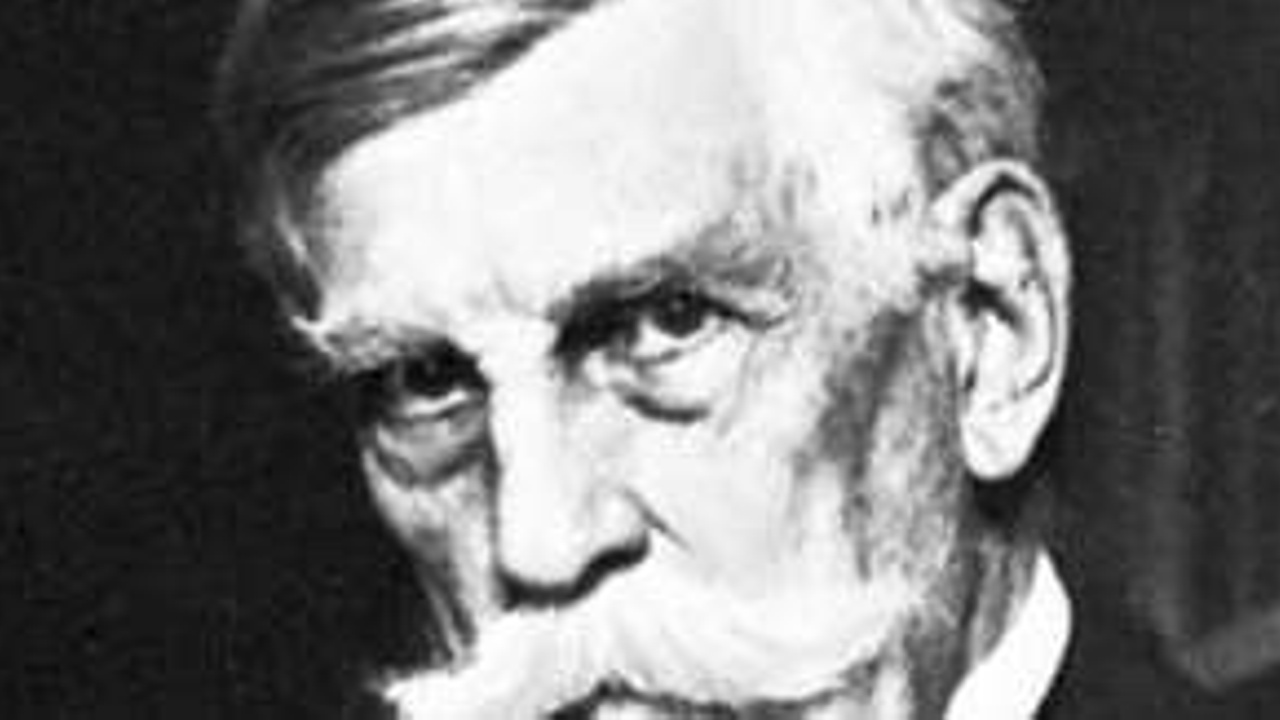
Civil War Veteran, Supreme Court Justice, legal historian, and one of the most respected jurists in American history, Oliver Wendell Holmes, Jr., was born On this Day, March 8, 1841, in Boston.

He was the Son of Oliver Wendell Holmes, Sr—the celebrated poet—and was the eldest of three children
A Civil War veteran of the Twentieth Massachusetts Volunteer Infantry, he was wounded 3 times at: the Battle of Ball’s Bluff (in the chest); Antietam (in the throat); Chancellorsville (in his foot).

At Antietam, Captain Holmes was struck by two bullets, one broke the buckle of his knapsack, the other pierced his neck. Holmes father famously recorded his search for his son in "My Hunt for the Captain." He traced him to Hagerstown, Maryland, and there found him on a train bound for home to recover from his wounds.

There are many stories about Holmes, but this one always comes to mind (albeit disputed), when, in July 1864, Confederal General Jubal Early’s forces were threatening Washington, DC. Holmes was chosen to escort President Abraham Lincoln to Fort Stephens on the outskirts of the city. Lincoln, anxious to witness his first battle, was so intrigued by the fighting that he climbed upon the rampart to get a better view. The sight of the tall, lanky president in this stovepipe hat immediately drew fire from the Confederate troops, but Lincoln was unfazed.
In a gentlemanly and subordinate manner, General Wright (Holmes’ Commanding General) attempted to convince the president to take cover, but he met with no success. It was obvious to Holmes that the president was not going to guard himself against the clear and present danger of the Confederate gunfire. Exasperated, Holmes shouted at Lincoln, “Get down, you fool!” The President immediately obeyed the command and later expressed his gratitude to Holmes: “Captain, I’m glad you know how to talk to a civilian.”

While actively avoiding promotions, Holmes rose to the rank of lieutenant colonel, but was mustered out at the rank of Captain—because the 20th Massachusetts had been decimated. Holmes received a brevet (honorary) promotion to colonel in recognition of his services during the war. He retired to his home in Boston after his three-year enlistment ended in 1864, weary and ill, his regiment disbanded.

During this busy time he was engaged in courtship. Always something of a ladies’ man, he had maintained a long friendship with Fanny Bowditch Dixwell, daughter of his onetime schoolmaster. She had waited patiently through wartime, his law studies, travel, and apprenticeship. Holmes and Dixwell were married at last on June 17, 1872. The marriage, happy and long lasting, was childless.

In December 1902, Holmes was appointed to the Supreme Court by President Theodore Roosevelt. He stayed on the court for 29 years, retiring on January 12, 1932, soon before his 91st birthday.

Holmes proved to be an independent spirit during his three decades on the Court, taking a contrarian position in so many decisions that he was dubbed the “Great Dissenter.” Well known for his brilliant legal reasoning, distinctive personality and writing style, he remains the oldest person to serve on the bench at 91 years. And most of his best decisions were written after he was 80 years old!

Throughout his nearly three decades on the bench, he ruled on cases spanning the whole range of federal law. He is remembered for prescient opinions on topics as widely separated as copyright, espionage, the law of contempt, the antitrust status of professional baseball, and the oath required for citizenship.
Profoundly influenced by his experience fighting in the American Civil War, Holmes helped move American legal thinking towards legal realism and judicial restraint, as summed up in his maxim: "The life of the law has not been logic: it has been experience."

In one of his most famous opinions, his dissent in Abrams v. United States (1919), he regarded the United States Constitution as "an experiment, as all life is an experiment" and believed that as a consequence "we should be eternally vigilant against attempts to check the expression of opinions that we loathe and believe to be fraught with death." He drafted the eternal maxim that “free speech would not protect a man in falsely shouting fire in a theatre and causing a panic,” thus formulating the groundbreaking clear and present danger test for a unanimous court.

His stories were legendary, and one that frequently comes to mind whenever we visit his gravesite was when Holmes was riding on a train one day and as the railroad ticket-checker began walking down the car, checking tickets.
When the ticket-checker approached, he watched Holmes searching his wallet, unable to find his ticket. Frustrated, Holmes then checked each of his pockets. Still he could not find his ticket.
Holmes grew more and more agitated with himself as he went through his briefcase, still unable to find his ticket.
The ticket-checker had finally made his way to Holmes’ seat.
“Justice Holmes,” he said, laughing, “I know who you are. Everyone knows who you are. There’s no need to show me your ticket.”
“Son, that’s not the problem,” said Justice Holmes. “The problem is that I can’t remember where I’m going.”
Fanny Holmes, devoted, witty, wise, tactful, and perceptive, died on April 30, 1929. Holmes wrote to his intimate friend, the English jurist Sir Frederick Pollock, “For sixty years she made life poetry for me and at 88 one must be ready for the end. I shall keep at work and interested while it lasts—though not caring very much for how long.”

He died two days before his 94th birthday, and was buried next to his wife at Arlington National Cemetery with full military honors that he had earned 70 years earlier during the Civil War.