
Football’s First Professional Player -- Who Played Longer than Any other Player in History--Wasn’t Recognized Until After his Death
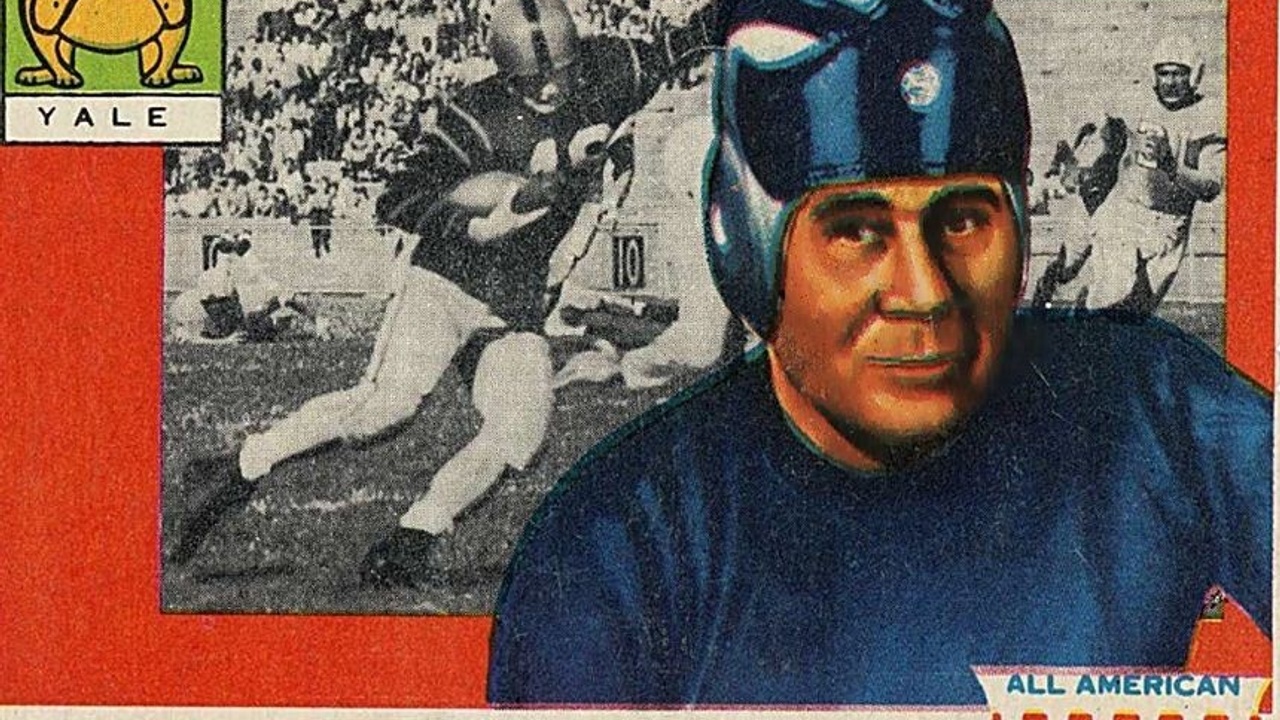
William Walter "Pudge" Heffelfinger became the first professional football player in 1892, when he was paid a $500 bonus (about $13,500 in today's money) after scoring the winning touchdown for the Allegheny Athletic Association against the Pittsburgh Athletic Club (4-0). A touchdown counted for 4 points at the time.

William was born in 1867 in the then-small city of Minneapolis. William's father was Major Christopher B. Heffelfinger and his mother was Mary Ellen Totton. Both his parents were born in Pennsylvania. Maj. Heffelfinger came by riverboat to Minneapolis, eventually joining the Union Army at the outset of the Civil War, was wounded at Gettysburg, and after the war started the family shoe manufacturing business and dabbled in real estate. During William's lifetime, the Heffelfinger family rose to prominence in Minneapolis.
As a boy, William Heffelfinger was nicknamed "Pudge". He played baseball and football in high school. Occasionally, during his junior and senior years of high school he also played for the University of Minnesota, in baseball, as a catcher, and in football, as a halfback.

He played baseball and football at Central High School in Minneapolis before he matriculated to Yale University. The 6 feet 3 inch, 210-pound Heffelfinger was a three-time All-American and played for Yale College in 1888-91. In his freshman year, the Yale team was undefeated, untied, and unscored upon. Heffelfinger also lettered in rowing, baseball, and track, and won the university heavyweight boxing championship.
His exceptional and natural athletic ability earned him legendary status while at Yale. Playing on both the offensive and defensive lines, Heffelfinger was named to Walter Camp’s All-American Team three times. Yale was a major football power during that time as Heffelfinger helped lead the team to undefeated seasons in 1888 and ’91 along with one-loss seasons in 1889 and 1890. The 1888 team amazingly outscored their opponents 698-0 that season.

Heffelfinger was especially big for that era and towered over his opponents. His size allowed him to wreak havoc on opposing lines where it was said he would typically take out two to three players at a time. He also is credited with introducing the “pulling guard” play. Famous sportswriter Grantland Rice once referred to Heffelfinger as the greatest guard of all-time. By the time his days at Yale had finished, “Pudge” not only lettered in football but he also lettered in baseball, rowing, and track.
Howard Knapp, one of the graduate coaches, motivated him by an unusual method:
The freshman Heffelfinger was 6 feet 3 inches in height, weighed 210 pounds and looked like the most demure, gentle, self-effacing individual that could be imagined. His usual posture was head bowed, shoulders stopped, eyes to the ground, with no idea whatever of his marvelous power and nature-given ability to strike terror in his opponents.
Knapp did everything possible by word and deed to arouse Heff so that he would give all he had in him for the good of the Yale team. Finally, at his wits end, Howard decided he would try the sight of blood to stir up Heff's dormant bellicose spirit.
He wrote Heff, with pen dipped in blood which be had obtained from a slaughter house, one of the sharpest, strongest of letters, using every reasonable form of expression to get Heff out of his lethargy. Heff, not knowing the nature of the gore, certainly must have been stirred, for the week after receiving the letter he played the best game of the season against Princeton.
Heff found himself that day and from then on was a terror to his opponents.
During Heffelfinger's four years playing for Yale under Camp, the team only lost two games. His teammates included, besides Pa Corbin: Alonzo Stagg, Charley Gill, Billy Rhodes, Lee "Bum" McClung and George Washington Woodruff. Heffelfinger felt that the greatest of these teams was the undefeated 1891 team he played on his senior year, which he described as "one of the best balanced teams I ever saw."

Heffelfinger's athletic activities at Yale were not limited to football: he lettered in three other sports: rowing, baseball and track, and won the university heavyweight boxing championship.
Following his days at Yale, Heffelfinger began a career in coaching where he made stops at the University of California, Lehigh University, and the University of Minnesota. He also frequently returned to Yale to help the football team prepare for contests against rivals Harvard and Princeton.

Heffelfinger married Grace Harriet Pierce in 1901. The couple remained married until his death in 1954.
After leaving Yale, Heffelfinger played amateur football for the Chicago Athletic Association (for which he was compensated with "double expenses", as was a common practice at the time). He was widely considered the best player at the time. Meanwhile, two Pittsburgh teams, the Allegheny Athletic Association (nicknamed the 3As) and the Pittsburgh Athletic Club had a heated rivalry and both were looking for an advantage in their upcoming game. Pittsburgh A.C. offered him $250 to play for them in the game, but he felt the amount was not enough to jeopardize his amateur status. The 3As doubled the amount and on the day of the game, Heffelfinger and two of his Chicago teammates were playing for the 3As. Although the payment for Heffelfinger's play was not published or admitted at the time, his presence set off quite a controversy as Pittsburgh A.C. protested the presence of the Chicago Athletic Association players in their line-up. Allegheny retaliated with the fact that Pittsburgh had imported players as well. The game ended in a 4–0 Allegheny win. Heffelfinger scored the game's only touchdown on a recovered fumble. A touchdown was only worth four points at the time.

The game was played at Recreation Park, which was located on Pittsburgh's north shore. The spot is marked by a historic marker.
The game was played at Recreation Park, which was located on Pittsburgh's north shore. The spot is marked by a historic marker.

After his official coaching career ended, Heffelfinger immersed himself in the business world in Minneapolis.
In the 1930s he founded Heffelfinger Publications which produced sales booklet for football and baseball equipment. He also spent time working for his father’s shoe business.
The business suffered heavily in the Panic of 1907, and was forced into bankruptcy in 1910, as were Heffelfinger and his father.
After the failure of the manufacturing business, Heffelfinger had an active career in real estate, including major commercial deals. In his real estate work, Heffelfinger is credited with important contributions to the early development of the upper Nicollet Avenue area.

Heffelfinger also found success in politics. He was a Minnesota delegate to the Republican National Conventions in 1904 and 1908. He also served as Hennepin (Minn.) County Commissioner from 1924-48. In 1930, During Prohibition Heffelfinger ran twice as a "wet" in the Republican primary for Minnesota's 5th congressional district losing both times to prohibitionist and former Lieutenant Governor William I. Nolan.
Throughout his life, “Pudge” maintained his playing shape. Even in his 40s, it was common for him to return to Yale and the coach would give him a jersey and let him play with the second team during practice. In the early 1920s he played in a professional game against the Columbus Panhandles which featured the famous Nesser brothers. He continued as a regular in pro charity games against much younger men, up until his mid-60s. He played his last organized football game in a charity event in Minneapolis at the age of 65.

His fame as the game’s first documented professional player surfaced after his death. “Pudge," who was inducted into the College Football Hall of Fame in 1951, died On This Day, April 2, 1954 at the age of 86. He was buried at the small Hawley Cemetery outside Blessing, Texas.


In the 1960s a man known only as "Nelson Ross" walked into the office of Art Rooney, the president of the Pittsburgh Steelers of the National Football League. After a brief discussion, the man gave Rooney a typed, 49-page manuscript about the early history of pro football. Ross' examination of Pittsburgh newspapers indicated that the first pro American football player actually was Pudge Heffelfinger, an all-American guard from Yale, who was hired to play for Allegheny on November 12, 1892 for $500 ($14.2 thousand in 2019 dollars). The Pro Football Hall of Fame soon discovered a page torn from an 1892 account ledger prepared by Allegheny manager, O. D. Thompson, that included the line item: "Game performance bonus to W. Heffelfinger for playing (cash) $500." Though the payment was not verified until the acquisition of an Allegheny Athletic Association expense ledger from the day by the Pro Football Hall of Fame, this fee established Heffelfinger as being the first professional American football player on record.