
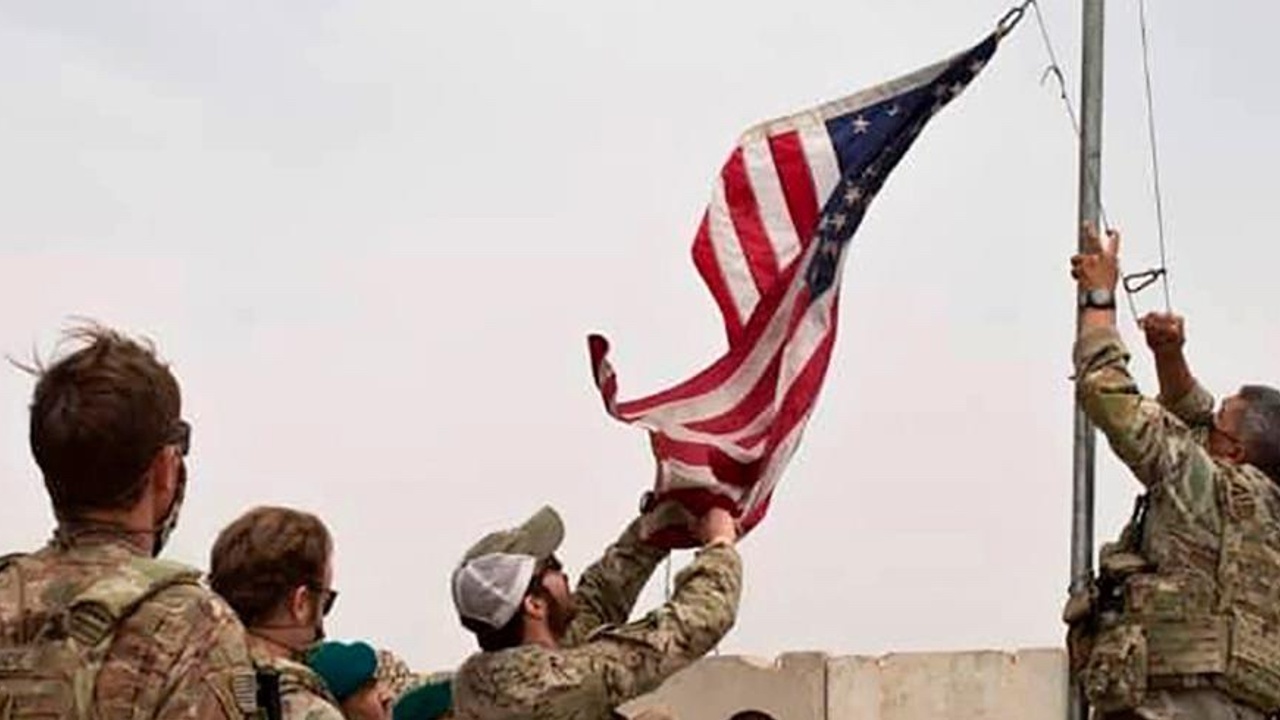
Over the past several days, I’ve been asked by many about the current situation in Afghanistan, and why we're seeing those tragic events unfold so rapidly. If you'd like the short version, what we're now witnessing is an abject failure of both operational and strategic leadership in Afghanistan, Brussels, and in Washington.

It's obvious that we haven't learned much since Somalia, let alone Vietnam.
Conflict Management in Perspective
There was a time when wars were decided largely by applying overwhelming force and maneuver to defeat an enemy...think World War I, World War II…Desert Storm...even the Cold War. As a nation, we tend to prefer those types of conflicts because victory is largely achieved through dominance. But today, the ways, means and ends of winning wars are more complex, deadly, and often far more unconventional than we'd like.

A Kitchen-Table Schematic of the Author's Crisis Resolution Cycle
One of the primary responsibilities of operational and strategic leaders charged with managing crises and wars is to negotiate and control operational transitions from crisis to conflict, and from termination to resolution. Controlling these transitions requires the ability to influence the duration, scope, intensity and stability of the conflict.
Easier said than done. And this is where we failed in Afghanistan.
Fast forward to the past few years. As opposing sides struggle to negotiate war termination from positions of strength, and advance their own agendas through unconventional and often violent means, the war termination phase can often be the most dangerous, volatile and politically charged. Emotions intensify, and animosities dissolve only over time.

As we're seeing in Afghanistan--and so many other past conflicts--the risks and sacrifices assumed during crisis-termination are immense and have dramatic force-protection implications.
Mission Creep (Swing) in Somalia
Two of those risks are Mission Creep and Mission Swing. The most glaring example, prior to the current situation in Afghanistan, was during our intervention in Somalia from 1992-1994, where we almost imperceptibly transitioned from feeding starving Somalis as part of Operation Provide Relief, to hunting down warlord General Mohamed Farah Aidid with UNOSOM II and Task Force Ranger forces in Mogadishu.

A vast asymmetry developed between US strategy and UN policy in Somalia, producing U.S. Mission swing and confused UN policy, ultimately leading to President Clinton’s withdrawal order on March 31, 1994.

Our experience in Somalia is a valuable study in how the legitimacy of an intervention and the nature of a crisis can be dramatically altered without well-articulated strategic objectives and thoughtful operational strategy.
It’s not enough to simply advocate an exit strategy, or to stress visualizing the intended end state.
It’s common to assume that after a crisis has been “terminated,” it has also been resolved. The tragedy we are witnessing today in Afghanistan is a direct result of confusing "War Termination" and "War Resolution"--not identifying the transition between both phases, and ultimately conflating them.
To disengage at the crisis termination phase is often like reopening the floodgates while the flood plain is still saturated. While others are dealing with past events and present realities, and while pressure invariably mounts to extricate forces from the crisis area, operational leaders have to visualize the road to self-sustaining peace and stability. We haven't done that in Afghanistan.

An enduring lesson from our Somalia experience is that counterstrategies of substitution and protraction aren’t susceptible to broad counterstrategies founded on dominance.
The Death of Operational Art?
Successful conflict management often proves elusive and difficult as conventional (traditional) theories of information and escalation domination eclipse real operational leadership. Addressing these realities on the ground is the essence of operational art. It seems we’ve almost entirely lost that talent, and those practitioners who are skilled in that domain.