
The Independence Day Discussion of July 4, 1776
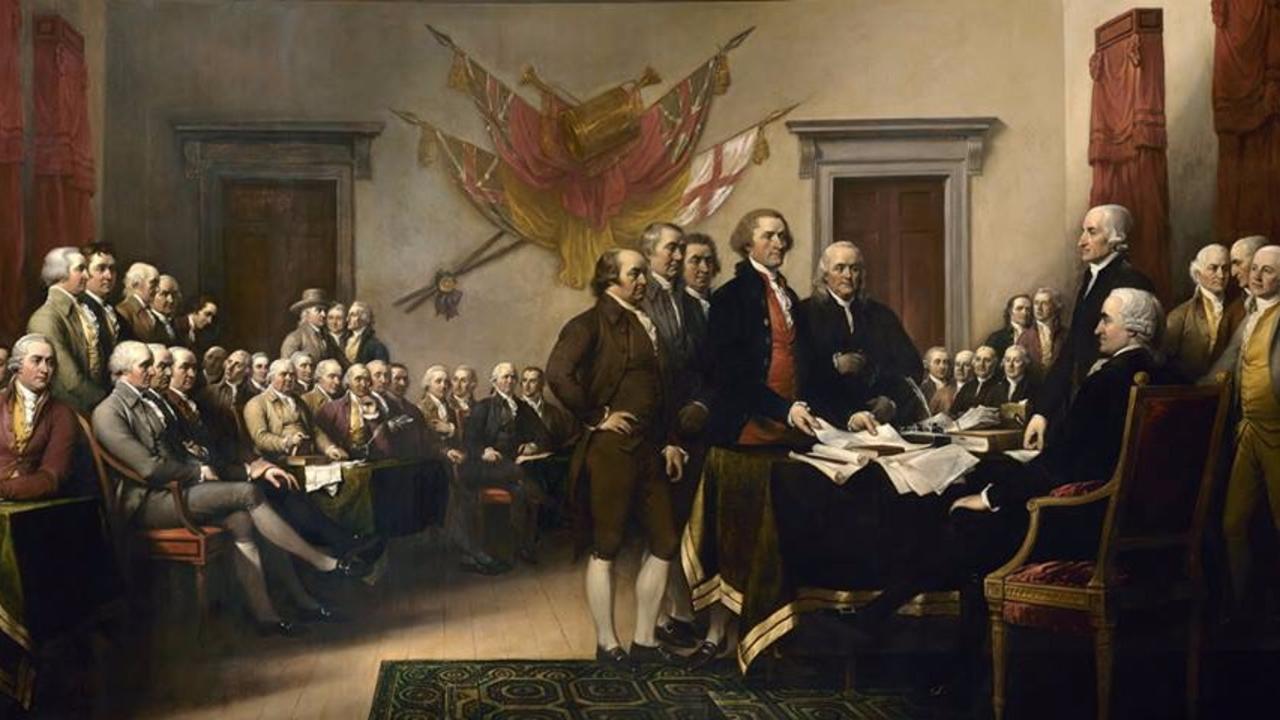
“When in the Course of human events….”
Words that came alive in the calm, concerned heads of men--aged twenty-six to seventy--from New York to South Carolina, all born in a foreign land. Assembled together in the frantic, summer air.
Rebelling against repeated injuries, usurpations, and tyranny, they met on that hot Philadelphia day, on the first of July, seventeen hundred and seventy-six.
And on the second day, 12 of 13 Colonies replied “Aye” to Richard Henry Lee’s motion for Independence from the King—a treasonable act, punishable by death, they knew.
Over the next two days and nights, Jefferson and the Committee of Five listened to the debate, with quill in hand.
“Let facts be submitted to a candid world,” one said.
“When should governments long established be changed? John Dickinson and the delegation from New York asked.
“Surely, prudently, not for light and transient causes,” the answer came. “And nor are these.”
“So what exactly are these sacred truths we hold?” Another asked. “That are so self-evident that they can be written in our blood, and measured out in our lives, one by one?”
“Those endowed by our Creator,” responded Ben Franklin, the elder man with the cane. “Weary for rights we never thought or noticed, until so deprived.”
John Adams nodded. “The laws of nature that inhabit us for not only a fleeting moment, but are vital to us all—like the air we breathe.”
“Aye, such as Life,” Franklin added. "C'est la vie."
“Liberty,” Mason said.
“And, thanks to Locke, we can say,” Jefferson commented, writing furiously, “the pursuit of happiness.”
“Tell me,” Dickinson interjected, against the grain. “With what pretext do we set ourselves on such a potentially ruinous course?
“Pretext?” Mifflin howled. “If it is pretext you seek, I can certainly inventory all the rights now made alien to us by the likes of King George.”
“That we should,” Sherman replied.
“And what, may I inquire,” Paca asked. “Is our strategy for this day?”
“To immediately publish and declare that these Colonies are united in the belief they ought be Free and Independent States,” Lee said.
“Hopefully to be completed before our Sunday rest,” Franklin lightly remarked.
“And what next?” Dickinson asked skeptically. “What does that mean for the Colonists of New York? Or Maryland, and Virginia?”
“That freedom is their right, “ Adams replied forcefully, and immediately. “And it is their duty, to throw off such Government when it cannot be changed.”
“Maybe your strange imaginings will lead you to the darkness of our collective graves?” Dickinson lamented. “When we refuse to petition once again, in advance?"
Rutledge shook his head with a smile. “Sir, in the beating of your wings, what you regard as a ‘maybe,’ remains clearly a ‘must’ for all of us.”
“I have my doubts,” he said. “That we shall succeed.”
“That does not surprise me, Sir,” Adams replied. “Say that to the Americans who perished at Lexington, Concord, and Bunker Hill. For some, losing is not too hard a skill to master. General Gage would approve. And yet for others, fate is not anything they fear. For me, defeat is not a result for which I am resigned.”
“And what of Britain should we succeed?” Francis Lewis openly inquired.
“We shall hold them, as we hold the rest of mankind,” Jefferson replied. "Enemies in War. In Peace, they shall be Friends.”
“I must confess, that is a vision too far for me to see,” Samuel Adams commented.
“With a firm reliance on the protection of God’s Providence,” Paca said with conviction, “We all must support this declaration.”
“And at what cost?” Dickinson asked. “Do we swim against this blood-dimmed tide?”
“To the gentlemen from New York, it is not your lack of conviction, I deplore,” Adams announced. “It is the passion and intensity with which you convey both your hesitation and your reservations.”
“For those reasons, precisely,” Dickinson replied. “New York will abstain.”
"So be it,” Adams nodded slightly to the rail thin man with disdain. “May you be pleased to walk alone. The real fight has yet begun, and it will surely come, like a torrent.”
Adjourning to the City Tavern for a feast of reason and a flow of soul, Jefferson led the toasts:
“My friends, o'er vales and hills, and with our solemn task ahead, to what do we now pledge?”
“Our Lives!” John Adams answered loudly.
“Our Fortunes!” Hancock shouted, pewter held high.
Our sacred Honor!” Franklin concluded, standing tall.
“Among us outcasts,” Charles Carroll raised his glass. “May our fledgling nation pay not too much for its birth.”
“Write us down in history, these last few days,” Jefferson quietly assured. “The taste of freedom is now as sweet as I can bear.”
Samuel Adams raised his glass of ale in response, “May we all feel our fates in what we cannot fear.”
“These days will be celebrated by all Americans,” John Adams agreed. “From this time forward forever more.”
--John Fenzel, Independence Day 2017